
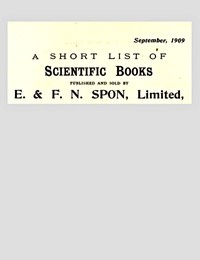
A Short List of Scientific Books Published and Sold by E. & F. N. Spon,…
Let's be clear from the start: this isn't a book with a plot in the traditional sense. There's no protagonist, no rising action. 'A Short List of Scientific Books...' is exactly what its title promises—a catalog from the London publishers E. & F. N. Spon, likely from the mid-to-late 1800s. It's a inventory of titles available for purchase, covering everything from practical engineering and architecture to chemistry, mathematics, and emerging industrial arts.
The Story
The 'story' here is told through the table of contents. Each entry is a clue. You see manuals on building railways, textbooks on steam engine mechanics, guides to architectural drawing, and treatises on subjects we now take for granted. The organization of the list itself tells a tale—it shows how knowledge was categorized for a professional, increasingly technical audience. The real narrative is in the gaps: Who was buying these? The self-made engineer? The student? The established professional? The catalog doesn't follow a character's journey, but it maps the journey of an entire society racing into the Industrial Age, one textbook at a time.
Why You Should Read It
I found this utterly captivating for one main reason: it makes history tangible. Reading a history book about the Industrial Revolution is one thing. But scanning this list makes you feel like you're holding the toolbox. You see the precise, nitty-gritty information people needed to turn grand ideas into iron, brick, and steam. It strips away the broad strokes and shows the how-to. There's a quiet poetry in titles like 'The Mechanic's Friend' or a guide to 'Cement and Concrete.' This catalog was a gateway. For me, it sparked a hundred questions about the daily lives and challenges of those builders and thinkers, making a distant era feel immediate and human.
Final Verdict
This is a niche gem, but a brilliant one. It's perfect for history buffs, especially those fascinated by the 19th century, the history of science, or the history of publishing. It's for readers who love primary sources and enjoy piecing together a bigger picture from small, authentic fragments. If you're the kind of person who gets lost in old maps, inventories, or catalogs, you'll find this strangely absorbing. It is not, however, for someone looking for a narrative-driven read. Think of it as a quiet museum exhibit in book form—a single, focused display case that tells a bigger story than you'd ever expect.
There are no legal restrictions on this material. Access is open to everyone around the world.
John Nguyen
1 year agoText is crisp, making it easy to focus.
James Clark
1 year agoHaving read this twice, the storytelling feels authentic and emotionally grounded. A true masterpiece.
Steven Martin
8 months agoComprehensive and well-researched.
Sarah Garcia
10 months agoSurprisingly enough, the narrative structure is incredibly compelling. Thanks for sharing this review.



Sarah Jackson
9 months agoHaving explored several resources on this, I find that the case studies and practical examples provided add immense value. Truly a masterpiece of digital educational material.