
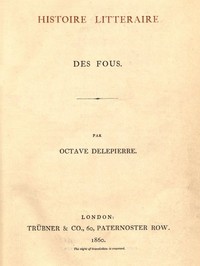
Histoire littéraire des Fous by Octave Delepierre
Published in 1860, Octave Delepierre's Histoire littéraire des Fous is a book that defies easy categorization. It's not a story with a plot in the traditional sense. Instead, think of it as a guided tour through a forgotten archive. Delepierre, a historian and archivist, spent his career gathering texts written by individuals confined to asylums, prisons, and other institutions. His book organizes and presents these fragments—poems, letters, philosophical treatises, and autobiographical accounts—giving a platform to voices society had silenced and labeled 'mad.'
The Story
There's no narrative arc here. The 'story' is the collection itself. Delepierre acts as a curator, introducing us to these anonymous or semi-anonymous writers. We read the passionate, often chaotic, and sometimes strikingly lucid works of people living on the absolute edges of 19th-century society. One moment you're reading a beautifully tragic love poem from a cell, the next a complex cosmological theory scribbled in an asylum. The book's structure is its argument: by presenting this 'literature of madness' seriously and systematically, Delepierre forces a confrontation. He shows that creativity and profound thought don't only exist in sanctioned, 'sane' spaces.
Why You Should Read It
This book stuck with me because of its deep humanity. Delepierre isn't a doctor analyzing symptoms; he's a scholar treating these writings as worthy of literary study. Reading it, you stop seeing 'ravings' and start hearing individual human beings trying to make sense of pain, love, God, and injustice. The raw emotion is palpable. It's a sobering reminder of how easily we dismiss people. The themes are timeless: who gets to define normal? Can great art come from immense suffering? It’s a challenging, sometimes uncomfortable read, but it expands your idea of what human expression can be.
Final Verdict
This isn't a beach read. It's for the curious reader who loves history, psychology, and unconventional books. Perfect for fans of quirky non-fiction, medical history, or anyone interested in the roots of outsider art. If you enjoyed books like The Man Who Mistook His Wife for a Hat or are fascinated by the history of mental health, Delepierre's strange and compassionate anthology will feel like discovering a secret library. Be ready for a fragmented, thought-provoking journey into the shadows of the 19th-century mind.
This content is free to share and distribute. Enjoy reading and sharing without restrictions.
Nancy Taylor
8 months agoI started reading out of curiosity and the plot twists are genuinely surprising. Worth every second.
Elizabeth Robinson
1 year agoThis book was worth my time since the flow of the text seems very fluid. Don't hesitate to start reading.
Paul Miller
9 months agoThis book was worth my time since the atmosphere created is totally immersive. A valuable addition to my collection.
Ethan Lee
1 year agoGood quality content.


Kenneth Thompson
1 year agoI came across this while browsing and the narrative structure is incredibly compelling. Definitely a 5-star read.