
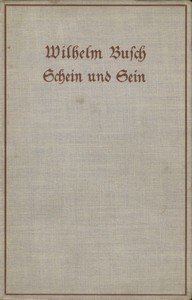
Schein und Sein: Nachgelassene Gedichte by Wilhelm Busch
Let's clear something up first: 'Schein und Sein' isn't a novel with a plot. It's a posthumous collection of poems, which means these are works Wilhelm Busch didn't publish in his lifetime. Reading it feels less like following a story and more like being handed a key to his private study.
The Story
There's no traditional narrative. Instead, the 'story' is the unfolding of a man's inner life. The poems move between sharp, witty observations about human hypocrisy and moments of profound melancholy. You'll read a few lines that mock a pompous townsman, then turn the page to find a quiet, aching poem about the silence of God or the relentless approach of death. It's this back-and-forth that creates the real tension. We see the celebrated humorist constantly bumping up against a deep-seated pessimism. The 'plot' is the unresolved battle between his public image (the 'Schein' or appearance) and his private reality (the 'Sein').
Why You Should Read It
I was genuinely surprised by how moving this collection is. Knowing Busch only for his cartoons, I expected more of the same—just in verse. I was wrong. These poems strip away the drawings and the slapstick. What's left is a raw, thoughtful voice. His humor is still there, but it's darker, more philosophical. He questions everything: religion, society's rules, even the purpose of his own art. It makes you see his famous comic strips in a new light. Maybe all that chaos with Max and Moritz was his way of laughing at a world he found pretty confusing and absurd. Reading this feels intimate, like you're getting a truth he wasn't ready to share with the world.
Final Verdict
This one's perfect for readers who love a good literary surprise and don't mind a book that makes them slow down and think. It's a must for anyone interested in Wilhelm Busch beyond the cartoons. Poetry fans who enjoy concise, impactful verse with a philosophical edge will find a lot to chew on. And if you've ever been curious about the 19th-century German mind—its doubts, its humor, its struggles with modernity—this is a fascinating, personal entry point. Just don't go in expecting more of 'Max and Moritz.' Go in ready to meet the man behind them.
This work has been identified as being free of known copyright restrictions. You do not need permission to reproduce this work.
Mary Moore
3 months agoThe clarity of the introduction set high expectations, and the emphasis on ethics and sustainability within the topic is commendable. The insights gained here are worth every minute of reading.
Donald Perez
3 months agoGreat value and very well written.
Kimberly Davis
5 months agoAfter a thorough walkthrough of the table of contents, the breakdown of complex theories into digestible segments is masterfully done. I feel much more confident in my knowledge after finishing this.
Anthony White
1 year agoSurprisingly enough, the pacing is just right, keeping you engaged. Exceeded all my expectations.



Joseph Perez
10 months agoIt’s refreshing to see such a high standard of digital publishing.