1

A Vindication of the Presbyteriall-Government and Ministry — Context and Discussion
7
2
Project Gutenberg
2014
Presbyterian Church -- Government; Church of England -- Government -- Early works to 1800; Congregationalism -- Early works to 1800; Separatists -- England -- Early works to 1800; Presbyterianism -- Apologetic works -- Early works to 1800
Readers of public-domain and historical texts
Project Gutenberg digital edition
en
Edition facts
Words: 53,401
Reading time: 233 min
Text sections: 7
Source:
Project Gutenberg record #44787
A 1649 London Provinciall Assembly defense of Presbyterian church government, structured as a series of numbered arguments and exhortations, using recurring images of purity, building, and light to counter Congregationalist and separatist challenges.
Editorial Edition Score
4.7/5
★★★★★
★★★★★
Calculated from edition completeness, EPUB availability, text structure and catalogue metadata. Not a user rating.
Edition quality
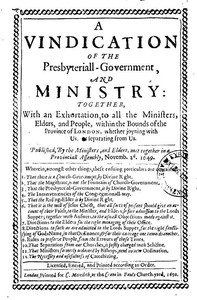
The work opens by framing its opponents' strategy as an attempt to "erect a throne for themselves, in the hearts of people" through slander—a metaphor that recurs throughout the text. The authors, ministers and elders of the London Provinciall Assembly, structure their vindication as a numbered series of doctrinal points and practical exhortations, each building on the last. The title page alone lists twelve distinct claims, from divine right of presbyterial government to the necessity of catechizing, giving the reader a clear map of the argument to come.
The excerpts reveal a text that moves between defensive polemic and pastoral instruction, often within the same paragraph. The authors address both those who join with them and those who separate, using direct second-person address to create a sense of urgent dialogue. The recurring image of the church as a building under construction—first the Temple in Jerusalem, then the local congregation—anchors their structural argument in concrete, biblical precedent.
Numbered Arguments and the Architecture of Persuasion
The work’s structure is itself an argument for order. Each major claim is assigned a number, and the text proceeds through them sequentially, from the divine right of church government to the impropriety of separating from established congregations. This numbered format mirrors the presbyterian emphasis on system and accountability. The excerpts show that the authors do not merely assert; they anticipate objections and answer them, often within the same numbered section. For instance, the claim that ruling elders are divinely instituted is followed by a list of duties and qualifications, turning doctrine into practical instruction. The reader is guided through a logical progression that mirrors the orderly governance the authors defend.
Purity as a Recurring Image
Throughout the excerpts, the language of purity and cleansing dominates. The authors exhort elders to "purge themselves of ignorance and scandal" before purging the church, using the biblical metaphor of the beam and the mote. They warn that sins in leaders are not merely sins but "monsters," and that elders are "like Looking-glasses" and "pictures in a glass-window"—images that emphasize visibility and reflection. The goal is a congregation that is not only "true" but "pure," a distinction that drives the argument for careful admission to the Lord's Supper. This emphasis on purity is not abstract; it is tied to specific practices, such as visiting families and examining faith, making the image concrete.
Movement Between Defense and Pastoral Exhortation
The text shifts fluidly between defending presbyterian polity and offering pastoral guidance. In one passage, the authors refute Congregationalist objections; in the next, they address elders directly: "labour to be good in all your relations." This dual movement reflects the work’s dual audience—both opponents and supporters. The exhortations are specific: elders should be "men of publique spirits," make their houses "little Churches," and abound in knowledge and godly conversation. The pastoral sections are not afterthoughts but integral to the vindication, demonstrating that presbyterian government produces not just correct doctrine but holy living. The structure thus enacts the argument that right order leads to right practice.
The Rhetoric of Urgency and the Threat of Division
The authors repeatedly invoke the danger of schism and the need for unity. They accuse separatists of being "unruly and vain talkers" who "subvert whole houses," and they plead with readers to consider how unity would "stop the mouthes of Anabaptists, Brownists, and Independents." The tone is urgent, even desperate: "We beseech you once more, by the blood of Jesus Christ." This rhetoric is not merely emotional; it is tied to the structural argument that presbyterian government is the divinely appointed means of preserving purity and peace. The threat of division is presented as both a spiritual and a practical danger, and the work’s closing exhortations aim to equip elders to prevent it through diligent oversight and personal holiness.
Readers approaching this work should attend to its dual nature: it is both a polemical defense and a manual for church officers. The numbered structure rewards sequential reading, but the pastoral exhortations can be read independently. The recurring images of building, light, and purity are not decorative; they carry the argument. Because the excerpts are incomplete, the full range of scriptural citation and the treatment of specific opponents remain to be discovered. The work is best understood as a document of its moment—1649, a year of political and ecclesiastical upheaval—and as a window into the practical concerns of London’s presbyterian leadership.
Reader reflection
Before you leave, reflect on the book
Use these questions to collect your thoughts before moving on.
Your progress
0
/
10
2
How much did you enjoy the reading experience?
3
Is this a title you would suggest to others?
4
How much effort did this book require?
5
How valuable was this book for your own interests?
6
Would a second reading be valuable?
7
How strong was your personal connection to the text?
8
What was the strongest part of the book?
9
What is the main idea you are taking away?
10