1

All Things are Possible — Edition Insights
2319
2
Project Gutenberg
2018
Philosophy; Russian literature -- History and criticism
Readers of public-domain and historical texts
Project Gutenberg digital edition
en
Edition facts
Words: 48,739
Reading time: 212 min
Text sections: 4
Source:
Project Gutenberg record #57369
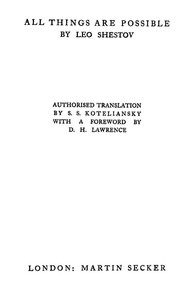
Lev Shestov's aphoristic critique of rationalism and ethics, translated by S.S. Koteliansky with a foreword by D.H. Lawrence. Shestov argues that genuine thought arises from despair and a relinquishing of logic, challenging idealism and the moral certainties of European philosophy.
In the foreword to this 1920 translation, D.H. Lawrence describes Russian literature as a 'surgical outcry' against European culture—a virus that Russians have absorbed and are now struggling to master. Lev Shestov's All Things Are Possible (originally The Apotheosis of Groundlessness) embodies that struggle in aphoristic, often paradoxical prose. Shestov does not build a system; he dismantles the assumption that philosophy must be systematic. His target is the 'eternal questions' and those who claim to solve them, whom he dismisses as having 'not even begun to think about them.'
The Thinker as Caricature
Shestov opens a central section by rejecting the romantic image of the philosopher as an 'eagle preparing for flight.' Instead, he offers a deliberately vulgar picture: 'a thinking man is one who has lost his balance,' with 'hands raking the air, feet flying, face scared and bewildered.' This is not tragedy but caricature—'helplessness and pitiable perplexity.' The passage grounds Shestov's method: he uses concrete, even comic, physical description to deflate intellectual pretension. He then applies this lens to Turgenev, citing the writer's late Poems in Prose and his letter to Tolstoy. Where Maupassant saw a 'giant with a silvery head,' Shestov sees a man 'pale, pitiful, fluttering like a bird that has been winged.' The contrast is deliberate: the public myth of the majestic patriarch versus the private reality of a dying writer grasping at literature for consolation. Shestov's point is not biographical but philosophical—the thinker, at the limit, has no system to fall back on.
Love, Compassion, and the Rejection of Idealism
In a striking reversal, Shestov argues that love and compassion lead not to idealism but to materialism. 'Love and sympathy chain the eye to the misery of this earth,' he writes, and a person who sees heaven's indifference will 'take upon himself the rôle of Providence.' The materialists, he notes, were 'mostly very good men'—a fact that bothered historians of philosophy. Shestov's logic is counterintuitive: if you truly care about others, you stop meditating and start acting. 'Man only thinks properly when he realises he has nothing to do, his hands are tied.' Profound thought, then, arises from despair, not from moral optimism. Optimism, by contrast, is a sign of 'narrow self-sufficiency' that 'dreads doubt.' Shestov does not endorse despair as a value; he observes it as a condition for genuine inquiry. The passage exemplifies his method of turning conventional ethical hierarchies upside down.
The Russian Spirit and European Culture
Lawrence's foreword frames the entire work as evidence against European culture. He argues that Russian literature is not 'spontaneous utterance' but a reaction to an imported virus. 'What the Russian is struggling with, crying out against, is not life itself: it is only European culture.' This diagnosis shapes how a reader might approach Shestov's aphorisms: they are not timeless truths but a specific, historical protest. Shestov himself, in the excerpted text, does not directly address this framing, but his method—attacking logic, system, and moral certainty—aligns with Lawrence's claim that Russia has been 'seething Europe down in a curious process of katabolism.' The book's original Russian title, The Apotheosis of Groundlessness, hints at Shestov's project: to find value not in firm foundations but in the absence of them. Readers should note that the English title, All Things Are Possible, shifts the emphasis from groundlessness to possibility.
Shestov's prose rewards slow, attentive reading. His aphorisms often contradict each other, and he offers no final synthesis. Readers may find it useful to track recurring images—the fluttering bird, the tied hands, the lost balance—as they reappear in different contexts. The foreword by Lawrence provides a provocative but partial lens; Shestov's own voice is more elusive. Approach the text as a series of experiments in thinking, not as a doctrine to be accepted or refuted.
Reader reflection
What did you think of this book?
Answer a few questions and save a private reflection on this device.
Your progress
0
/
10
2
How much did you enjoy the reading experience?
3
Would you recommend this book to another reader?
4
How demanding did the text feel?
5
Did the book meet your expectations?
6
How useful were the ideas in this book?
7
Which part made the strongest impression?
8
How personally connected did you feel to the book?
9
What did this book teach you most?
10