1

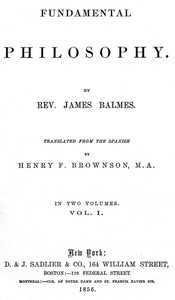
Fundamental Philosophy, Vol. 1 (of 2) — Reading Companion
(0 User reviews)
928
Project Gutenberg
2015
Not confirmed
Philosophy, Spanish
Readers of public-domain and historical texts
Project Gutenberg digital edition
en
Edition facts
Words
171,241
Reading time
745 min
Text sections
90
For Fundamental Philosophy, Vol. 1 (of 2) — Reading Companion, the stored edition analysis reports 171,241 words, 12 hr 25 min estimated reading time, and 90 detected text sections.
The text analysis averages about 26.8 words per sentence, while the detected sections provide another way to judge how the source is divided.
Project Gutenberg metadata also associates the work with “Philosophy, Spanish,” connecting these edition facts with the source record’s subject description.
Source:
Project Gutenberg record #48149
Balmes examines certainty, evidence, and the limits of human knowledge through a critique of Descartes, Kant, and common sense, using vivid examples like imagining the Column of the Place Vendôme to distinguish internal from external phenomena.
Read the complete public-domain text at its original source.
Read on Project GutenbergBalmes opens his inquiry into certainty not with abstract definitions but with a concrete problem: how do we distinguish the internal phenomena of imagination from the external sensations that force themselves upon us? In a striking passage, he describes a dying person—'his countenance pale and damp with sweat, his wandering eyes'—to show that while we can suppress such images by mental effort, we cannot avoid seeing and hearing the actual scene. This contrast between will-dependent internal representations and will-independent external sensations becomes the pivot for his entire epistemology.
The Will and the Real: A Phenomenological Distinction
Balmes devotes sustained attention to the role of the will in shaping our mental life. He argues that purely internal phenomena, such as recalling the Column of the Place Vendôme or imagining a journey from Madrid to the Thames, are subject to our command: 'I produce in my imagination, whenever I please, a scene … and I suppress it at my pleasure.' Yet external sensations resist such control. When standing before a dying person, one cannot choose to stop seeing or hearing him. This asymmetry, Balmes contends, reveals a fundamental difference in the order of phenomena. He extends the point by contrasting the freedom of internal travel—where one can 'take steps of a hundred leagues' without fatigue—with the rigid sequence of actual travel, which demands 'a true resolution to depart' and subjects one to all accompanying inconveniences. The will's dominion over internal phenomena is not absolute; exceptional cases, such as haunting images, require effort to dispel. But even then, engaging in a 'complicated calculation' can make them disappear. This nuanced analysis avoids simple dualism and instead maps a spectrum of dependence.
Critique of Foundational Principles: Descartes, Kant, and Common Sense
The table of contents reveals Balmes's systematic engagement with major philosophical positions. He devotes chapters to Descartes's principle 'I think,' the principle of contradiction, Kant's synthetic judgments a priori, Vico's criterion, and Lamennais on common consent. In the excerpt, he does not yet deliver his full critique, but the structure signals a methodical approach: each chapter tests a candidate for the foundation of certainty. Balmes insists that the question of certainty is both important and useful, and he distinguishes between 'certainty of the human race' and 'philosophical certainty.' This suggests he will argue that ordinary certainty does not require the elaborate justifications philosophers demand. His treatment of Kant is particularly notable: chapter XXIX asks whether 'true synthetic judgments a priori in the sense of Kant' exist, indicating a direct engagement with Kantian epistemology. The excerpts do not reveal his conclusion, but the framing implies a critical stance toward transcendental idealism.
The Objective Value of Ideas and the Limits of Representation
Balmes's chapter titles point to a central concern: the objective value of ideas. He asks whether all cognitions can be reduced to the perception of identity, and he examines the 'problem of representation' in relation to Leibniz's monads. The excerpt's discussion of internal phenomena touches on this: if I can represent the Thames without passing through France and Spain, my mental representation is not constrained by the spatial order of external reality. This freedom raises the question of how ideas relate to objects. Balmes distinguishes between 'immediate intelligibility' and the representation of causality and ideality. He seems to argue that the senses alone cannot produce transcendental science—knowledge that holds necessarily and universally. The chapter 'Existence of Transcendental Science in the Absolute Intellectual Order' suggests he posits a higher intellectual order beyond sensory experience. His analysis of the will's influence on internal phenomena serves as a laboratory for testing the reliability of different kinds of cognition, preparing the ground for his own criterion of evidence.
Readers approaching this volume should attend to Balmes's method: he builds his argument through careful phenomenological observation before advancing metaphysical claims. The excerpts show a philosopher who tests abstract principles against concrete mental experiences, such as the contrast between imagining a journey and actually taking one. His engagement with Descartes, Kant, and Lamennais is not merely historical but serves to clear the ground for his own position. The second volume continues the inquiry, but this first book establishes the framework for a realist epistemology grounded in the distinction between will-dependent and will-independent phenomena.
Rain fell against the window while I read Balmes on the Column of the Place Vendôme, that imagined pillar standing between thought and stone. Later, the same quiet certainty unravelled in a newer voice. His critique of absolutes softened into something practical, almost provisional. The rain kept falling, and I wandered into Reconstruction in Philosophy — Context and Discussion, feeling the old questions breathe differently.
There are no reviews for this eBook.
There are no comments for this eBook.
Reader reflection
How will you remember this book?
Save your reaction, strongest insight, and memorable passage.
Your progress
0
/
10
2
How much did you enjoy the reading experience?
3
How likely are you to recommend this book?
4
What was the reading difficulty like?
5
What was the strongest part of the book?
6
Did the story or argument move comfortably?
7
Could you follow the author’s main argument?
8
How did the reading compare with what you expected?
9
What is the main idea you are taking away?
10