1

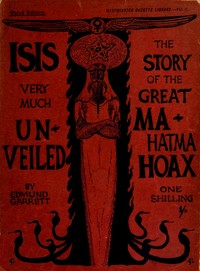
Isis very much unveiled, being the story of the great Mahatma hoax — Reading Notes
(0 User reviews)
565
Project Gutenberg
2019
Not confirmed
Blavatsky, H. P. (Helena Petrovna), 1831-1891; Besant, Annie, 1847-1933; Judge, William Quan, 1851-1896; Theosophy -- Controversial literature; Olcott, Henry Steel, 1832-1907
Readers of public-domain and historical texts
Project Gutenberg digital edition
en
Edition facts
Words
50,287
Reading time
219 min
Text sections
11
The catalog record for Isis very much unveiled, being the story of the great Mahatma hoax — Reading Notes provides practical reading context through 50,287 words, 3 hr 39 min estimated reading time, and 11 detected text sections.
The text analysis averages about 19.1 words per sentence, while the detected sections provide another way to judge how the source is divided.
Project Gutenberg metadata also associates the work with “Blavatsky, H. P. (Helena Petrovna), 1831-1891,” connecting these edition facts with the source record’s subject description.
Source:
Project Gutenberg record #60119
Edmund Garrett's 1895 exposé of the Theosophical Society, using internal documents and testimony to argue that its leaders fabricated the Mahatma letters. The book reprints facsimiles, challenges W.Q. Judge, and includes Annie Besant's reluctant admission of a prima facie case.
Read the complete public-domain text at its original source.
Read on Project GutenbergGarrett opens with a Pompeii analogy: the temple of Isis preserved a secret passage used by priests for producing 'phenomena.' He promises to show the 'secret passage in the temple of the Theosophic Isis' while the temple is still operating. The preface immediately distinguishes his exposure from the earlier Psychical Research report by noting that here the 'high-priesthood' gives evidence against itself. His stated role is merely to ensure they 'satisfactorily get at one another.'
The Structure of the Attack
The book is divided into three parts plus a postscript. Part I narrates 'The Story of the Great Mahatma Hoax' in thirteen short chapters, from 'No Mahatmas, no Members!' through 'The Climax of Theosophic Brotherhood' to 'Questions and Challenges.' Part II collects 'Answers and Theosophistries' from officials, prominent members, and private members. Part III is 'A General Rejoinder' titled 'Last Shreds of the Veil of Isis.' The postscript covers 'Mr. Judge’s Mahatma at Bay' and includes a reply from Judge and an 'Appreciation' of that reply. This layered structure lets readers follow the controversy as it unfolded.
The Besant Letter as Internal Evidence
A crucial excerpt is a letter from Annie Besant, reproduced in the preface. She describes reading Garrett’s opening chapters and initially thinking 'Chestnuts!' because the old Psychical Research exposure had not killed the society. She explains that she and others had read the Psychical Report, analysed it, and joined anyway. But she concedes that as Garrett’s 'newer case' proceeded, 'the situation altered.' She states that 'the details are too precise, and supported by too much evidence' to escape the conclusion that a 'primâ facie case has been established against Mr. Judge.' This internal admission is the book’s central piece of evidence.
The Challenge to Judge and the Society
Besant’s letter also issues a direct challenge to W.Q. Judge, the Theosophical Society’s vice-president. She demands a 'crushing, triumphant reply' and warns that if he declines to answer, she will 'sadly and reluctantly' leave the society. She appeals to 'all honest Theosophists' to pressure Judge into responding. Garrett frames this as the climax of his exposure: the high-priesthood turning on itself. The book includes facsimiles of Mahatma letters and of Judge’s handwriting, allowing readers to compare and judge the authenticity claims.
Reading the Facsimiles and Appendices
The text is accompanied by numerous illustrations and facsimiles, including portraits of Blavatsky, Besant, and Olcott, the 'Mahatma’s Seal,' the 'Envelope Trick,' and facsimiles of Mahatma missives and Judge’s handwriting. These visual documents are integral to Garrett’s argument. Readers should examine them alongside the text, as they are referenced directly. The postscript includes Judge’s own reply and an 'Appreciation' of it, offering a counterpoint. The index is detailed, listing chapters and page numbers for easy navigation through the controversy.
Garrett’s book is best read as a documentary exposé rather than a narrative. The preface and Besant’s letter provide the interpretive key: the case rests on internal contradictions and admissions. Readers should pay close attention to the facsimiles and the sequence of challenges and responses. The book does not claim to settle the matter but to present evidence that demands an answer from the Theosophical leadership.
Reading Garrett’s old pages, I kept thinking how easily we forget the human weight behind grand claims. That same quiet persistence of belief—and its cost—lingers in The Woman Movement — Text and Context, where hope and doubt sit side by side, as they always do.
There are no reviews for this eBook.
There are no comments for this eBook.
Reader reflection
How did this book work for you?
Your answers remain private and are stored only in this browser.
Your progress
0
/
10
2
How did the book work for you overall?
3
How likely are you to recommend this book?
4
Did the language feel accessible?
5
How strong was your personal connection to the text?
6
How useful were the ideas in this book?
7
Was the book what you thought it would be?
8
How much did the book move you?
9
In one sentence, what did you learn?
10