1

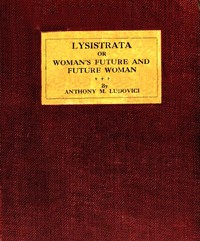
Lysistrata — Context and Discussion
(0 User reviews)
1327
Project Gutenberg
2023
Not confirmed
Women; Women -- Social and moral questions
Readers of public-domain and historical texts
Project Gutenberg digital edition
en
Edition facts
Words
27,111
Reading time
118 min
Text sections
7
For Lysistrata — Context and Discussion, the stored edition analysis reports 27,111 words, 1 hr 58 min estimated reading time, and 7 detected text sections.
The text analysis averages about 31.1 words per sentence, while the detected sections provide another way to judge how the source is divided.
Project Gutenberg metadata also associates the work with “Women,” connecting these edition facts with the source record’s subject description.
Source:
Project Gutenberg record #69734
Ludovici's 1925 polemic uses the Lysistrata figure to argue against women's emancipation, linking declining birth rates and artificial feeding to women's increased activities outside the home, drawing on medical and eugenic arguments.
Read the complete public-domain text at its original source.
Read on Project GutenbergAnthony M. Ludovici's Lysistrata; or, Woman's Future and Future Woman (1925) is not a translation or adaptation of Aristophanes' comedy but a polemical essay that borrows the title figure to argue against contemporary women's movements. Published in the To-day and To-morrow series alongside works by J. B. S. Haldane and Bertrand Russell, the book deploys medical, evolutionary, and eugenic reasoning to diagnose what Ludovici sees as a crisis in Western civilization: declining birth rates, rising artificial infant feeding, and women's increasing participation in public life. The excerpts reveal a text structured around recurring contrasts—natural versus artificial, maternal duty versus personal ambition, physiological health versus degeneration—that Ludovici uses to frame women's choices as civilizational threats.
A Polemic in Series Context
Ludovici's book belongs to the To-day and To-morrow series, a collection of short speculative works by prominent intellectuals of the 1920s. The series list includes J. B. S. Haldane's Daedalus, Bertrand Russell's Icarus, and Dora Russell's Hypatia—the last a feminist counterpoint to Ludovici's own volume. This context matters because Ludovici positions his argument as a scientific and futurological intervention, not merely a cultural complaint. The foreword by Dr. Norman Haire, a sexologist and birth control advocate, signals the book's engagement with medical authority, even as Haire notes he disagrees with many of Ludovici's views. The series format—short, provocative, and aimed at a general educated audience—shapes the book's rhetorical structure: bold claims, sweeping historical generalizations, and a tone of urgent diagnosis.
The Rhetoric of Decline and Substitution
Ludovici's argument hinges on a pattern he identifies across multiple domains: the replacement of natural functions with artificial substitutes. In the excerpts, this is most explicit in his discussion of infant feeding. He cites Dr. Janet E. Lane Claypon to assert that breast-feeding capacity is 'practically universal' among English women, yet artificial feeding has become popular due to women's 'increased activities outside the home.' Ludovici frames this as a civilizational failure: 'we have once more neglected the effort to restore natural conditions, in order to apply all our ingenuity to the task of bringing artificial aids to perfection.' The same logic—natural decline met with technological compensation—recurs throughout the book, applied to childbirth, domestic labor, and women's social roles. Ludovici's language is consistently binary: 'natural' versus 'artificial,' 'normal' versus 'abnormal,' 'health' versus 'degeneration.'
Medical Authority and Its Limits
Despite his reliance on medical evidence, Ludovici is sharply critical of the medical profession. The foreword by Haire acknowledges this: 'you seem very hard on the medical profession.' Ludovici accuses doctors of complacency in accepting artificial feeding and of prioritizing profit over prevention. He notes that under the 'present idiotic system of paying the doctor better for illness than for health,' doctors have little incentive to promote natural methods. Yet he simultaneously invokes medical authorities—Lane Claypon, obstetric hospital observations—to support his claims. This tension between using and attacking medical expertise is a structural feature of the book: Ludovici positions himself as a defender of true science against a corrupted profession. The excerpts do not reveal whether he extends this critique to other fields, but the pattern is established.
Movement Between Scenes: From the Nursery to Civilization
The excerpts show Ludovici moving rapidly from specific physiological details—the composition of mother's milk, the effects of diet during pregnancy—to sweeping pronouncements about 'the Women's Movement' and 'the situation' of modern society. This movement between micro and macro scales is a key structural device. A paragraph on the 'enormous popularity of artificial feeding' becomes a condemnation of women's 'increased activities outside the home,' which is then linked to 'the decline in the function' and the rise of 'scientific technique.' Ludovici does not linger on individual cases or narratives; his evidence is statistical and authoritative, his conclusions categorical. The effect is to make every personal choice—whether to breastfeed, whether to work—appear as a civilizational decision with eugenic consequences.
Readers approaching Lysistrata should be aware that the excerpts represent only a fraction of the book's argument, focused on infant feeding and women's work. The full text likely extends this logic to other domains—marriage, education, politics—using the same rhetorical patterns. Ludovici's style is assertive and repetitive, building his case through accumulation rather than narrative. The book is best read as a period document of early twentieth-century anxieties about gender, reproduction, and modernity, not as a work of social science or history.
Decades past, I’d shelve Ludovici’s stern pamphlet beside a gentler, older plea for understanding. Both worry over the family’s quiet unraveling, yet one speaks with a clenched fist, the other with an open hand. That 1921 speech, Love—Marriage—Birth Control Being a Speech delivered at the Church Congress at Birmingham, October, 1921 — Reading Companion, seems to whisper the very anxieties its louder neighbor shouts. They are strange bedfellows, sharing a worry, though never a glance.
There are no reviews for this eBook.
There are no comments for this eBook.
Reader reflection
Your personal reading reflection
Build a private reading journal entry for this title.
Your progress
0
/
10
2
What was your overall reaction to the book?
3
Is this a title you would suggest to others?
4
How much effort did this book require?
5
Did it raise ideas you would like to talk about?
6
Did the story or argument move comfortably?
7
Did the book meet your expectations?
8
Could you follow the author’s main argument?
9
What did this book teach you most?
10