1

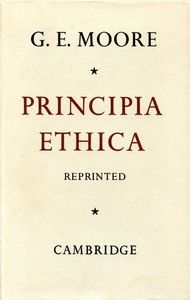
Principia Ethica — A Reader’s Guide
189
2
Project Gutenberg
2016
Ethics
Readers of public-domain and historical texts
Project Gutenberg digital edition
en
Edition facts
Words: 101,888
Reading time: 443 min
Text sections: 16
Source:
Project Gutenberg record #53430
Moore argues that ethical questions are often confused due to failure to distinguish 'what kind of things ought to exist for their own sakes' from 'what kind of actions ought we to perform.' He critiques naturalistic and metaphysical ethics, insisting that 'good' is a simple, indefinable property known by intuition.
Editorial Edition Score
4.8/5
★★★★★
★★★★★
Calculated from edition completeness, EPUB availability, text structure and catalogue metadata. Not a user rating.
Edition quality
G. E. Moore opens Principia Ethica by diagnosing a persistent source of confusion in moral philosophy: the tendency to answer questions without first determining what precisely is being asked. He identifies two distinct kinds of ethical questions—one about what ought to exist for its own sake, the other about what actions we ought to perform—and argues that philosophers have routinely conflated them. This foundational distinction shapes the entire work, as Moore proceeds to examine and reject rival ethical systems on the grounds that they commit what he calls the 'naturalistic fallacy': the attempt to define the simple, indefinable property of 'good' in terms of something else.
The Naturalistic Fallacy and the Indefinability of Good
Moore devotes the opening chapters to establishing that 'good' is a simple, non-natural property that cannot be analyzed or defined in terms of any natural object or property. He argues that any attempt to equate 'good' with pleasure, desire, or any empirical quality commits the naturalistic fallacy. This fallacy, he contends, underlies the errors of hedonism, utilitarianism, and evolutionary ethics. Moore illustrates his point by insisting that even if we could identify what things are good, the question 'Is this thing good?' remains open and distinct from any factual description. The property of goodness, he maintains, is known only through intuition—a direct, self-evident apprehension that cannot be proved or disproved by empirical evidence.
Hedonism and Its Internal Contradictions
In Chapter III, Moore subjects hedonism—the view that pleasure is the sole good—to rigorous criticism. He distinguishes between egoistic hedonism (my own greatest pleasure is the sole good) and universalistic hedonism or utilitarianism (the greatest pleasure of all is the sole good), arguing that these two positions are not merely different but strictly contradictory. If hedonism is true, egoism cannot be, and vice versa. Moore points out that Sidgwick, a leading exponent of hedonism, fails to recognize this contradiction. Moreover, Moore argues that even if hedonism were true, the utilitarian end would not be the best conceivable, but only the best possible for us to promote. He concludes that the refutation of hedonism follows from the more fundamental error of trying to define 'good' in terms of pleasure.
Metaphysical Ethics and the Reality of Non-Natural Objects
Chapter IV addresses metaphysical ethics—theories that derive ethical conclusions from metaphysical premises, as seen in the works of the Stoics, Spinoza, Kant, and Hegelian writers. Moore credits metaphysicians with recognizing that not everything that exists is a natural object; they have drawn attention to entities such as numbers and truths that do not exist in time. However, he argues that they mistakenly treat 'good' as if it were a metaphysical entity that can be inferred from metaphysical truths. Moore insists that goodness itself does not exist in time, but the things that are good can exist. He uses the example of arithmetic truths—'Two and two are four'—to illustrate that such truths do not exist yet are meaningful. This distinction, he claims, is essential for understanding the unique status of ethical propositions.
Readers approaching Principia Ethica will benefit from attending closely to Moore's repeated insistence on clear question-asking. The book is structured as a series of critical examinations of rival theories, each evaluated against the standard of whether it respects the indefinability of 'good.' Moore's prose is precise and argumentative, often proceeding by careful distinctions and refutations. The work rewards patience with its analytical rigor, even as it challenges many common assumptions about the foundations of morality.
Reader reflection
How will you remember this book?
Save your reaction, strongest insight, and memorable passage.
Your progress
0
/
10
2
How much did you enjoy the reading experience?
3
Would you encourage someone else to read it?
4
How demanding did the text feel?
5
Do you expect to return to this book?
6
Did the book offer a fresh perspective?
7
Did the book give you something worth debating?
8
What did you appreciate most?
9
What is the main idea you are taking away?
10