1

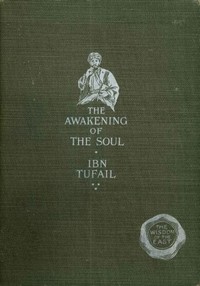
The Awakening of the Soul — Reading Notes
(0 User reviews)
1230
Project Gutenberg
2010
Not confirmed
Islamic philosophy -- Early works to 1800; Philosophy, Arab -- Early works to 1800
Readers of public-domain and historical texts
Project Gutenberg digital edition
en
Edition facts
Words
24,453
Reading time
107 min
Text sections
3
This digital edition of The Awakening of the Soul — Reading Notes is described by source-level measurements including 24,453 words, 1 hr 47 min estimated reading time, and 3 detected text sections.
The text analysis averages about 29.1 words per sentence, while the detected sections provide another way to judge how the source is divided.
Project Gutenberg metadata also associates the work with “Islamic philosophy -- Early works to 1800,” connecting these edition facts with the source record’s subject description.
Source:
Project Gutenberg record #34572
This editorial note examines the language, narrative voice, and shifts in pace in Paul Brönnle's 1910 translation of Ibn Tufayl's philosophical tale, focusing on how the text moves from concrete, sensory details to abstract reasoning.
Read the complete public-domain text at its original source.
Read on Project GutenbergPaul Brönnle's 1910 translation of Ibn Tufayl's The Awakening of the Soul renders a 12th-century Arabic philosophical narrative into English with a distinctive voice that oscillates between vivid, sensory description and dense, scholastic argument. The text's opening sections follow the isolated protagonist Hayy Ibn Yokdhan through concrete, physical experiences—learning to imitate animal calls, covering himself with leaves, and grieving the death of a roe—before shifting into abstract contemplation of celestial motion and the nature of the Creator. This transition is not abrupt but gradual, marked by a change in sentence length and syntactic complexity.
Concrete Beginnings and Sensory Detail
The early chapters ground the narrative in tangible, physical actions. Hayy is described as a boy of seven who “covers himself with leaves,” later “covers himself with the skin of an Eagle,” and “spreads terror among the beasts.” The prose is direct, with short clauses and a focus on observable events. The death of the roe prompts a visceral reaction: Hayy “takes an aversion to the dead body” and “buries the body of the Roe.” These passages rely on concrete nouns and active verbs, creating a pace that is brisk and immediate. The translator preserves the episodic structure of the original, with each paragraph advancing a discrete action or observation. This sensory richness establishes a world of cause and effect, where Hayy learns through trial and error.
Shift to Abstract Reasoning
As Hayy matures, the narrative voice changes markedly. In the fourth and fifth septenaries, the text becomes dominated by logical deduction and philosophical argument. Sentences grow longer and more complex, often employing conditional structures: “if we affirm that its motion has no beginning, it necessarily follows that the power that moves is not inherent in its own body.” The translator uses terms like “diffused,” “dispersed,” and “abstracted from bodies,” signaling a move from empirical observation to metaphysical speculation. The pace slows as the text works through syllogisms about the finitude of bodies and the nature of the mover. This section relies heavily on repetition and reformulation, as if the narrator is patiently guiding the reader through each step of reasoning. The shift is not total—concrete examples like “gravity in a stone” anchor the abstractions—but the overall rhythm becomes more deliberate and meditative.
Voice of the Translator and Textual Texture
Brönnle's translation choices shape the reading experience. He retains archaic spellings and inconsistent italics, as noted in the transcriber's note, which gives the text a period flavor. The use of “septenary” to divide Hayy's life into seven-year stages imposes a structural clarity that the original may not have had. The translator also inserts occasional explanatory phrases—for example, “to wit, either in the body of the thing moved or else through some other body without it”—that clarify but also slow the argument. The narrative voice is consistently third-person omniscient, but it shifts from a storyteller's tone in the early sections to a lecturer's tone in the philosophical passages. This dual voice creates a tension between the tale's folkloric origins and its didactic purpose, a tension that is characteristic of the work's place in the Wisdom of the East series.
Readers attentive to shifts in pace will notice how the text alternates between narrative momentum and philosophical deliberation. The early chapters reward those who enjoy descriptive, action-driven prose, while the later sections demand patience with abstract argument. Brönnle's translation preserves this duality, making the work accessible to both casual readers and those interested in Islamic philosophy. The book's structure—organized into septenaries—offers natural pausing points for reflection.
Reading the early chapters of The Awakening of the Soul, I was struck by how concrete details softly give way to abstraction—that same quiet drift I remember feeling in The Works of George Berkeley. Vol. 1 of 4: Philosophical Works, 1705-21 — A Reader’s Guide. Both seem to begin with the world's texture, then gently ask me to let it go.
There are no reviews for this eBook.
There are no comments for this eBook.
Reader reflection
What was your reading experience?
Capture what you thought, learned, and would like to remember.
Your progress
0
/
10
2
How much did you enjoy the reading experience?
3
Would you recommend this book to another reader?
4
Did the language feel accessible?
5
Which part made the strongest impression?
6
Would you read this book again?
7
How did the reading compare with what you expected?
8
How personally connected did you feel to the book?
9
Which lesson or insight stayed with you?
10