1

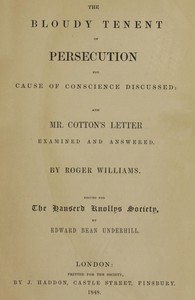
The Bloudy Tenent of Persecution for Cause of Conscience Discussed and Mr. Cotton's Letter Examined and Answered — A Closer Reading
(0 User reviews)
3276
Project Gutenberg
2021
Not confirmed
Church and state -- Early works to 1800; Cotton, John, 1584-1652; Liberty of conscience -- Early works to 1800; Persecution -- Early works to 1800; Baptists -- New England -- Early works to 1800
Readers of public-domain and historical texts
Project Gutenberg digital edition
en
Edition facts
Words
163,585
Reading time
712 min
Text sections
184
The catalog record for The Bloudy Tenent of Persecution for Cause of Conscience Discussed and Mr. Cotton's Letter Examined and Answered — A Closer Reading provides practical reading context through 163,585 words, 11 hr 52 min estimated reading time, and 184 detected text sections.
The text analysis averages about 25.3 words per sentence, while the detected sections provide another way to judge how the source is divided.
Project Gutenberg metadata also associates the work with “Church and state -- Early works to 1800,” connecting these edition facts with the source record’s subject description.
Source:
Project Gutenberg record #65739
Roger Williams's 1644 polemic against religious persecution, framed as a dialogue between Truth and Peace, argues that civil magistrates have no jurisdiction over conscience. This edition, edited by Edward Bean Underhill for the Hanserd Knollys Society, includes extensive scriptural and historical reasoning, with Williams challenging John Cotton's defense of state-enforced religion.
Read the complete public-domain text at its original source.
Read on Project GutenbergRoger Williams's The Bloudy Tenent of Persecution for Cause of Conscience (1644) is a sustained argument against the use of civil power to enforce religious conformity. Written as a dialogue between Truth and Peace, the work systematically rebuts the position of John Cotton, a leading Puritan minister in New England. This edition, edited by Edward Bean Underhill for the Hanserd Knollys Society, presents the text with a historical introduction that situates Williams's arguments within the broader Baptist tradition of advocating for liberty of conscience. The excerpts reveal a dense, scripture-laden style, with Williams drawing on Old Testament examples—such as the decrees of Nebuchadnezzar, Cyrus, Darius, and Artaxerxes—to distinguish between permissible state toleration and improper state coercion in matters of worship.
Dialogue Form and Argumentative Strategy
Williams structures the work as a conversation between Truth and Peace, a device that allows him to present objections and counterarguments in a dynamic format. In the excerpts, Peace poses questions about the extent of civil authority over the church, and Truth responds with detailed scriptural exegesis. For instance, when discussing whether magistrates should confirm Christ's laws, Truth argues that God's cause never stood in need of a temporal sword, citing 1 John v. 9. This dialogic method enables Williams to address Cotton's points directly while advancing his own thesis: that civil rulers may permit or tolerate worship but cannot compel it. The form also reflects the contentious nature of the debate, as Williams anticipates and dismantles opposing views.
Scriptural Interpretation and Historical Precedent
Williams grounds his argument in a close reading of biblical narratives, particularly the actions of gentile kings. He examines Ezra's thanksgiving for Artaxerxes' decree permitting Jews to return to Jerusalem, but insists this does not imply that the king had authority over worship. Williams distinguishes between a ruler's permission to practice religion and the imposition of a state religion, noting that the king did not compel all his subjects to adopt Jewish worship. Similarly, he cites Nebuchadnezzar, Cyrus, and Darius as examples of rulers who favored God's people without abandoning their own idolatry. These precedents serve to limit the magistrate's role: they may protect civil peace but must not meddle with souls. Williams's method is to take each scriptural proof offered by his opponents and reinterpret it to support his own position.
The Role of Civil Magistrates and Church Membership
A central question in the excerpts is how far church members are subject to civil laws. Williams acknowledges that all persons, including clergy, are bound to obey just laws, citing Romans 13:1. He condemns the Catholic exemption of clergy from civil subjection as sinful. However, he argues that this subjection does not extend to matters of conscience or worship. The excerpts show Williams grappling with the tension between the church's spiritual authority and the state's temporal power. He insists that magistrates should not charge themselves with the spiritual peace of souls, only with the civil peace of bodies and goods. This distinction is crucial to his overall argument: while church members remain citizens, their religious obligations are not subject to civil enforcement.
Readers approaching this work should attend to its dialogic structure and the way Williams uses scripture to redefine the limits of political authority. The excerpts offer only a partial view of his argument, but they reveal a careful thinker who anticipates objections and grounds his claims in detailed biblical analysis. This edition's editorial apparatus, including Underhill's introduction, provides context for Williams's place in Baptist history and the broader struggle for religious liberty.
Sitting with Williams’s dialogue between Truth and Peace, I remembered arguing with a cousin years ago about whether belief could ever be forced. He kept citing order; I kept thinking of my grandmother’s quiet defiance. Later, reading The Subjection of Women — Key Ideas to Explore, I felt that same ache—conscience and personhood refusing to be governed from outside.
There are no reviews for this eBook.
There are no comments for this eBook.
Reader reflection
What did you think of this book?
Answer a few questions and save a private reflection on this device.
Your progress
0
/
10
2
Did this book hold your interest?
3
How likely are you to recommend this book?
4
How much effort did this book require?
5
Was the book moving at the right speed?
6
What was the strongest part of the book?
7
How useful did the reading feel?
8
Do you expect to return to this book?
9
Which lesson or insight stayed with you?
10