1

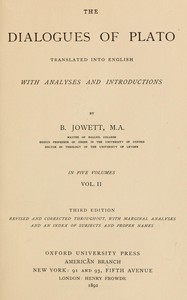
The dialogues of Plato in five volumes, Vol. 2 (of 5) — A Closer Reading
(0 User reviews)
393
Project Gutenberg
2025
Not confirmed
Philosophy, Ancient; Dialogues, Greek -- Translations into English
Readers of public-domain and historical texts
Project Gutenberg digital edition
en
Edition facts
Words
219,124
Reading time
953 min
Text sections
47
For The dialogues of Plato in five volumes, Vol. 2 (of 5) — A Closer Reading, the stored edition analysis reports 219,124 words, 15 hr 53 min estimated reading time, and 47 detected text sections.
The text analysis averages about 22.9 words per sentence, while the detected sections provide another way to judge how the source is divided.
Project Gutenberg metadata also associates the work with “Philosophy, Ancient,” connecting these edition facts with the source record’s subject description.
Source:
Project Gutenberg record #76464
This second volume of Jowett's Plato translation includes Meno, Euthyphro, Apology, Crito, Phaedo, and Gorgias, with marginal analyses and introductions. The editorial note focuses on the dialogues' argumentative structure, recurring images of healing and punishment, and the movement between abstract definition and dramatic confrontation.
Read the complete public-domain text at its original source.
Read on Project GutenbergThe second volume of Benjamin Jowett's five-volume translation of Plato opens with the Meno, a dialogue that begins abruptly with a question about whether virtue can be taught. Socrates immediately deflects, claiming ignorance of virtue itself. This pattern—a direct query met with a request for definition—recurs throughout the volume. In Euthyphro, Socrates asks for a definition of piety; in the Apology, he defends his method of cross-examination; in Crito, he debates the obligation to obey laws; in Phaedo, he discusses the immortality of the soul; and in Gorgias, he argues that doing injustice is worse than suffering it. Jowett's marginal analyses, preserved as sidenotes, guide the reader through each argument's twists.
Abrupt Beginnings and the Search for Definitions
The volume's dialogues share a structural pattern: they start in medias res with a question or challenge. Meno opens with 'whether virtue can be taught'; Euthyphro begins with Socrates encountering Euthyphro at the court; the Apology starts with Socrates addressing his accusers. This abruptness forces the reader into the midst of a living debate. Socrates consistently responds by demanding a definition of the key term—virtue, piety, justice—before any further discussion can proceed. In Meno, when Meno offers an enumeration of virtues, Socrates insists on a single common notion. This method of definition by division and collection is a recurring structural device, often leading to aporia or a shift in the argument's direction.
Recurring Images: Healing, Punishment, and the Soul
Throughout the volume, Plato employs a cluster of images drawn from medicine and punishment. In Gorgias, Socrates compares justice to a healing art: as medicine cures the body, punishment cures the soul of injustice. He argues that the unpunished criminal is more miserable than the punished one, because the soul remains diseased. This analogy appears earlier in Phaedo, where Socrates speaks of philosophy as a practice of death, a purification of the soul from the body. The image of the soul as something that can be harmed or improved recurs in Meno when Socrates discusses whether virtue is teachable. Jowett's marginal notes highlight these connections, drawing attention to the ethical framework that links physical health to moral well-being.
Movement Between Scenes: From Street to Prison
The volume's dialogues are set in varied locations, each influencing the tone and stakes. Euthyphro takes place at the porch of the king-archon, a public legal space; the Apology is set in a courtroom; Crito occurs in Socrates' prison cell; Phaedo is narrated from the prison on the day of Socrates' death. This movement from public to private, from argument to impending execution, creates a dramatic arc across the volume. In Gorgias, the setting shifts to a private house, where Socrates confronts Polus and Callicles. The change of scene often marks a change in argumentative style: in the Apology, Socrates speaks directly to a large audience; in Crito, he engages in a quiet, intimate dialogue. Jowett's introductions and analyses help the reader track these shifts.
Jowett's Apparatus: Marginal Analyses and Sidenotes
This edition is distinguished by its extensive scholarly apparatus. Jowett provides an introduction and analysis for each dialogue, summarizing the argument step by step. The marginal analyses, originally printed alongside the text, have been preserved as sidenotes in this digital edition. They offer a running commentary, often condensing a page of argument into a single phrase, such as 'Socrates reminds Meno that this is only an enumeration of the virtues.' These notes serve as a guide for readers navigating the dense dialectic. The transcriber's note explains that the sidenotes in italics with a blue background are original page headers, while the non-italic ones are the marginal analyses. This dual system allows the reader to distinguish between structural markers and interpretive summaries.
Readers approaching this volume will benefit from paying attention to the interplay between Jowett's marginal analyses and the dialogue text itself. The analyses often clarify the logical steps, but they also reflect Jowett's own interpretive choices. The volume's structure—moving from definitional puzzles to dramatic confrontations—rewards careful attention to how each dialogue builds on the previous one. Whether read sequentially or individually, these translations offer a window into Plato's methods of inquiry and Jowett's Victorian scholarly perspective.
Reading the Phaedo again, I felt that quiet ache of watching Socrates choose his end without flinching—the way healing and punishment blur into one another there. It reminded me of sitting beside another old friend, Academica — Inside the Classic, where the same uncertain rhythm of question and pause lingers. Strange, how two books can share one afternoon’s light.
There are no reviews for this eBook.
There are no comments for this eBook.
Reader reflection
How did this book work for you?
Your answers remain private and are stored only in this browser.
Your progress
0
/
10
2
Did this book hold your interest?
3
How likely are you to recommend this book?
4
How easy was the book to follow?
5
Would you like to discuss this book with someone?
6
Did any part of the book stay with you emotionally?
7
Which aspect of the book did you value most?
8
How valuable was this book for your own interests?
9
What is the main idea you are taking away?
10