1

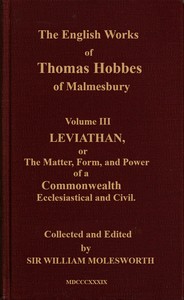
The English works of Thomas Hobbes of Malmesbury, Volume 03 (of 11) — Reading Companion
(0 User reviews)
638
Project Gutenberg
2024
Not confirmed
Philosophy, English -- 17th century
Readers of public-domain and historical texts
Project Gutenberg digital edition
en
Edition facts
Words
217,999
Reading time
948 min
Text sections
32
For The English works of Thomas Hobbes of Malmesbury, Volume 03 (of 11) — Reading Companion, the stored edition analysis reports 217,999 words, 15 hr 48 min estimated reading time, and 32 detected text sections.
The text analysis averages about 32.8 words per sentence, while the detected sections provide another way to judge how the source is divided.
Project Gutenberg metadata also associates the work with “Philosophy, English -- 17th century,” connecting these edition facts with the source record’s subject description.
Source:
Project Gutenberg record #73957
This volume of Hobbes's collected works presents Leviathan, his treatise on the structure of sovereign power, civil obedience, and the interpretation of scripture. The text examines the tension between authority and liberty, the role of miracles in religious belief, and the necessity of a commonwealth founded on rational pact.
Read the complete public-domain text at its original source.
Read on Project GutenbergHobbes opens his dedication to Francis Godolphin with a striking image of the difficulty of navigating between those who contend 'for too great liberty' and those who contend 'for too much authority.' This framing sets the central tension of Leviathan: the need to define a sovereign power that is absolute enough to secure peace yet limited enough to avoid tyranny. The work proceeds through a systematic argument that begins with the state of nature and culminates in a detailed analysis of ecclesiastical and civil authority.
The Dedication and Its Context
The dedication to Francis Godolphin is not merely a formal courtesy. Hobbes explicitly connects his discourse to the memory of Sidney Godolphin, praising his 'generous constitution of his nature' as a model of virtue. This personal tribute grounds the abstract political theory in lived moral character. Hobbes also acknowledges the risk of his undertaking: 'in a way beset with those that contend...’tis hard to pass between the points of both unwounded.' The dedication thus foreshadows the work’s controversial reception and its attempt to steer a middle course between royalist and republican extremes.
Miracles, Prophecy, and Political Authority
In a key passage on biblical interpretation, Hobbes argues that miracles alone are insufficient to authenticate a prophet. He cites Deuteronomy and Matthew to show that false prophets may perform wonders, and that the true test is whether the prophet’s teaching conforms to established religion and does not incite rebellion against the sovereign. Hobbes draws a direct equivalence: 'revolt from the Lord your God' is 'in this place equivalent to revolt from your king.' This move subordinates religious revelation to civil obedience, a cornerstone of his political theology. The discussion reveals Hobbes’s method of using scripture to support his rationalist framework.
The Structure of the Commonwealth
Hobbes’s definition of the commonwealth as a 'Matter, Form, and Power' is reflected in the work’s tripartite structure. The excerpts show his concern with the 'seat of power' abstracted from particular persons, comparing it to the 'simple and unpartial creatures in the Roman Capitol' that defended those within not because of who they were but because they were there. This metaphor underscores Hobbes’s insistence on the impersonality of sovereign authority. The text systematically builds from the natural condition of mankind to the institution of a commonwealth by covenant, and then to the rights and duties of sovereigns and subjects.
Readers approaching this volume should attend to Hobbes’s careful use of scripture as evidence for his political conclusions. His method is to reason from first principles about human nature, then to test those principles against biblical authority. The result is a work that is both a philosophical treatise and a polemical intervention in the religious controversies of its time. The marginal notes and chapter divisions help trace the argument’s progression from natural right to civil law.
Leviathan’s cold, rational architecture has always reminded me of a stone cathedral—awe-inspiring, yet requiring an act of will to find warmth within. But there is a quieter thread, a worry about the moral life beneath all that logic, that I find echoed elsewhere. Outlines of a Critical Theory of Ethics — Reading Notes seems to ponder that same shadow, the very human cost of such perfect orders. They sit differently on my shelf, yet share a secret conversation.
There are no reviews for this eBook.
There are no comments for this eBook.
Reader reflection
What did you think of this book?
Answer a few questions and save a private reflection on this device.
Your progress
0
/
10
2
Was reading this book enjoyable?
3
How likely are you to recommend this book?
4
How easy was the book to follow?
5
Could you see yourself revisiting this book?
6
Did it raise ideas you would like to talk about?
7
Was the book what you thought it would be?
8
Did this book create an emotional response?
9
What did this book teach you most?
10