1

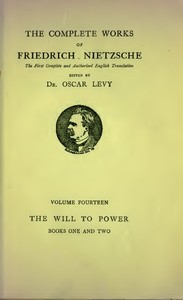
The Will to Power: An Attempted Transvaluation of All Values. Book I and II — A Reader’s Guide
209
2
Project Gutenberg
2016
Values; Nihilism (Philosophy); Power (Philosophy)
Readers of public-domain and historical texts
Project Gutenberg digital edition
en
Edition facts
Words: 90,161
Reading time: 393 min
Text sections: 10
Source:
Project Gutenberg record #52914
Nietzsche's fragmentary work diagnoses European nihilism as a consequence of failed moral and religious valuations, then critiques religion, morality, and philosophy through aphoristic arguments that trace the origin and decay of ideals.
The two books collected here form the opening of Nietzsche's projected magnum opus, assembled from his notebooks by editors after his collapse. The structure is deliberately fragmentary: numbered aphorisms, often only a paragraph long, move between diagnosis and critique. The first book, 'European Nihilism,' treats nihilism not as a philosophical position but as a historical condition—an 'outcome' of prior valuations. The second book turns to 'A Criticism of the Highest Values That Have Prevailed Hitherto,' dissecting religion, morality, and philosophy in turn. The translator's preface notes that the work was intended to clarify doctrines from Thus Spake Zarathustra after widespread misunderstanding.
Aphoristic Structure and the Plan
The volume opens with a 'Plan' that outlines a multi-book architecture, yet the text itself proceeds by numbered sections that often feel provisional. Aphorisms range from a single sentence to several paragraphs, and the numbering is continuous within each book. This form mirrors Nietzsche's method: each fragment is a self-contained strike against a received idea. The plan announces topics—'Nihilism as an Outcome,' 'The Crisis'—but the execution is more associative than systematic. Readers should expect abrupt shifts and recurring motifs rather than linear argument.
Recurring Imagery of Decay and Exhaustion
Throughout the excerpts, Nietzsche uses organic metaphors of decline: Christianity is 'nearing its stage of exhaustion,' its function reduced to 'soothing diseased nerves.' The 'barbarity of the notions among which we Europeans still live' is contrasted with a lost capacity for 'strength to seek, to struggle, to dare.' The image of an 'opiate' Christianity recurs, alongside the claim that 'Buddhism is secretly gaining ground all over Europe.' These figures frame nihilism not as an intellectual error but as a symptom of physiological and cultural decadence.
Critique of Moral and Religious Origins
The second book's sections on religion and morality trace how valuations arise from historical conditions. Nietzsche questions the origin of 'the fatal belief in Divine Providence' and its secular survivals under terms like 'Nature' and 'Progress.' He attacks the 'psychological falsity' of imagining a 'thing-in-itself' that is good, wise, and mighty, suppressing the causality by which such qualities emerge. The critique extends to the 'herd' morality and the domination of virtue, always grounding ideals in power relations rather than transcendent truths.
Movement Between Diagnosis and Polemic
The text oscillates between analytical diagnosis—naming nihilism as a historical movement—and sharp polemic, as when Nietzsche calls the Church's interpretation of the Bible 'nonsense' that should 'turn the colours of our bodies permanently into the red of shame.' This dual movement gives the work its tension: it is both a philosophical history of error and a rhetorical assault on contemporary culture. The translator's preface underscores that Nietzsche wrote to correct misunderstandings, yet the fragmentary form leaves many arguments incomplete, inviting the reader to supply connections.
Because these are edited notebooks, the reader encounters Nietzsche's thought in its raw, exploratory state. The aphorisms reward rereading: a single numbered section often contains a compressed argument that unfolds only when placed alongside others. Pay attention to the recurring contrast between strength and exhaustion, and to the way Nietzsche uses historical examples—Pascal, Christianity, Darwinism—as symptoms of deeper valuations. The work is best approached as a workshop of ideas rather than a finished treatise.
Reader reflection
What did you think of this book?
Answer a few questions and save a private reflection on this device.
Your progress
0
/
10
2
Was reading this book enjoyable?
3
Would you encourage someone else to read it?
4
How easy was the book to follow?
5
How much did the book move you?
6
How distinctive were its ideas or approach?
7
Did the book meet your expectations?
8
What did you appreciate most?
9
Which lesson or insight stayed with you?
10