1

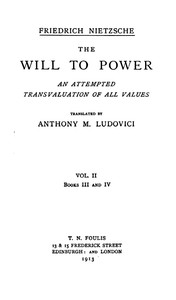
The Will to Power: An Attempted Transvaluation of All Values. Book III and IV — Themes and Context
(0 User reviews)
1469
Project Gutenberg
2016
Not confirmed
Values; Nihilism (Philosophy); Power (Philosophy)
Readers of public-domain and historical texts
Project Gutenberg digital edition
en
Edition facts
Words
103,386
Reading time
450 min
Text sections
12
The Will to Power: An Attempted Transvaluation of All Values. Book III and IV — Themes and Context can be approached with a clearer sense of reading commitment from its source measurements: 103,386 words, 7 hr 30 min estimated reading time, and 12 detected text sections.
The text analysis averages about 24.9 words per sentence, while the detected sections provide another way to judge how the source is divided.
Project Gutenberg metadata also associates the work with “Values,” connecting these edition facts with the source record’s subject description.
Source:
Project Gutenberg record #52915
Nietzsche's posthumous notes, edited as Books III and IV of The Will to Power, apply his principle of valuation to science, art, society, and the individual, arguing that knowledge is a schematizing imposition and that freedom is measured by resistance overcome.
Read the complete public-domain text at its original source.
Read on Project GutenbergNietzsche's The Will to Power, Books III and IV, extends his principle of valuation into science, art, society, and the individual. The translator's preface notes that Nietzsche 'boldly carries his principle still further' and 'does not shrink from showing its application even to science, to art, and to metaphysics.' A key aphorism (515) declares: 'The object is not "to know," but to schematise,—to impose as much regularity and form upon chaos as our practical needs require.' This volume thus presents knowledge as a function of the will to power, not as disinterested discovery.
Science as Schematization
In Part I of Book III, Nietzsche challenges the neutrality of scientific knowledge. Aphorism 515 asserts that science is as arbitrary as art in its procedure, imposing order on chaos for practical ends. The translator emphasizes that the scientist's knowledge is 'the outcome of his inexorable will to power interpreting facts' according to the self-preservative conditions of his group. This perspectivism undercuts any claim to objective truth, framing epistemology as a biological instrument. Nietzsche's method is to expose the will to power operating even in the most abstract domains, such as logic and causality, which he treats as human impositions rather than reflections of reality.
The Individual Against the Herd
Aphorism 766 identifies a 'fundamental error': treating the herd as an aim instead of the individual. The herd is 'only a means and nothing more,' yet modern thought grants it higher rights. Nietzsche counters that the individual is 'something quite new, and capable of creating new things,' an absolute who must seek valuation in himself. Aphorism 767 adds that even interpreting a traditional formula is a personal, creative act. This section contrasts the predatory, self-assertive 'ego' (768) with altruistic gregariousness, which Nietzsche links to man's slow growth. Freedom, he argues in 770, is measured by 'the degree of resistance which has to be continually overcome' to remain at the top, requiring tyrants to become free.
Discipline and the Order of Rank
Book IV, titled 'Discipline and Breeding,' outlines a hierarchy of human types. The table of contents lists sections on 'The Order of Rank,' 'The Strong and the Weak,' 'The Noble Man,' 'The Lords of the Earth,' 'The Great Man,' and 'The Highest Man as Lawgiver of the Future.' Nietzsche's language is stark: one must be 'uppermost or nethermost—like a worm, despised, annihilated, trodden upon' (770). The 'free ages' when the 'sovereign man' appears are 'certainly not humane times.' This vision of breeding a higher type through discipline and danger culminates in the figures of Dionysus and Eternal Recurrence, which close the volume. The excerpts do not reveal the full argument, but the trajectory is clear: a transvaluation of all values through the cultivation of strength.
Readers approaching these books should note that they are compiled from Nietzsche's unpublished notes, not a finished work. The aphoristic style demands attention to individual assertions and their cumulative force. Nietzsche's critique of science and morality is not merely destructive; it aims to clear ground for a new valuation. The recurring image of the 'hundred swords of Damocles' suggests that freedom and danger are inseparable. This volume rewards those willing to engage with its provocative, often unsettling, claims.
Reading Nietzsche’s insistence that freedom is measured by resistance overcome, I thought of my grandfather’s garden—how the stubborn soil made every harvest feel earned. The same quiet stubbornness surfaces in The Sayings of Confucius, where virtue isn’t given but practiced daily. The Sayings of Confucius — Story, Setting & Ideas reminded me that both thinkers ask us to shape ourselves, not merely admire the shaping.
There are no reviews for this eBook.
There are no comments for this eBook.
Reader reflection
What did you think of this book?
Answer a few questions and save a private reflection on this device.
Your progress
0
/
10
2
How did the book work for you overall?
3
Would you recommend this book to another reader?
4
How much effort did this book require?
5
How useful did the reading feel?
6
Did the story or argument move comfortably?
7
Was the book easy to understand?
8
Did any part of the book feel personally relevant?
9
What is the main idea you are taking away?
10