1

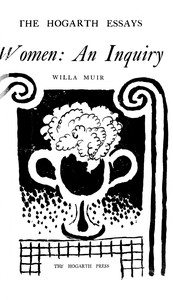
Women: an inquiry — Background and Themes
(0 User reviews)
706
Project Gutenberg
2025
Not confirmed
Women; Women -- Social and moral questions
Readers of public-domain and historical texts
Project Gutenberg digital edition
en
Edition facts
Words
14,083
Reading time
62 min
Text sections
4
Before opening Women: an inquiry — Background and Themes, the edition data offers a quick orientation: 14,083 words, 1 hr 2 min estimated reading time, and 4 detected text sections.
The text analysis averages about 24.2 words per sentence, while the detected sections provide another way to judge how the source is divided.
Project Gutenberg metadata also associates the work with “Women,” connecting these edition facts with the source record’s subject description.
Source:
Project Gutenberg record #76398
Willa Muir's 1925 essay examines whether sexual difference is spiritual as well as physical, arguing that conventional morality reflects a masculine standpoint and that women's creative role involves fostering individual wholeness against institutional values.
Read the complete public-domain text at its original source.
Read on Project GutenbergWilla Muir opens Women: an Inquiry by asking whether the difference between men and women, if essential, can be formulated as distinctively human and sexual. She quickly dismisses external traits and social behaviours as non-essential, citing the Vaertings' work on how subordinate sexes in dominant-sex states are similarly labelled less intelligent and courageous. Muir insists that men and women share a joint human nature, capable of the same qualities, and that apparent differences stem from power and subordination rather than innate sexual character.
The Search for an Essential Difference
Muir sets out to find a difference that is both spiritual and sexual, rejecting secondary characteristics and social roles as contingent. She argues that in male-dominated states, women are excluded from complete development and exhibit a 'slave psychology,' while in matriarchal societies the reverse occurs. This leads her to conclude that courage, intelligence, and other traits are too broadly human to define sexual difference. Instead, she posits that sexual differentiation may modify even the least reactions, but she lacks the scientific data to pursue that path. The essay thus narrows its focus to a spiritual distinction: women derive strength from unconscious life and are concerned with growth, while men are oriented toward intellectual and organisational activity.
Vertical Lines and Horizontal Strata
A striking metaphor emerges: women see humanity 'in vertical lines,' each individual growing like a tree, while men see it 'in horizontal strata,' grouping individuals into social systems. Muir argues that women's business is the perfection of each unique person, fostering harmony and strength through creative love, which she calls the fundamental attribute of womanhood. Men, by contrast, focus on the relation of individuals to their neighbours and on building institutions. These two aspects are continuous and inseparable, differing only in emphasis. Muir insists that women cannot disregard any human impulse; virtues and vices alike must be fused into the whole, not lopped off. This holistic view stands in tension with the masculine tendency toward logical extremes that can become inhuman.
The Need for New Moral Values
Muir contends that conventional morality expresses a man's standpoint, not a woman's, and that creative women require independent moral values. She traces the over-emphasis of masculine activities to a historical period when civilisation needed organisation more than individual freedom. Now, the discrepancy between human and institutional values is so great that even men feel it acutely, and women are being forced into the open. Muir anticipates a 'really creative New Woman' emerging as conventional morality weakens among women. However, she cautions that women alone cannot save humanity; men must face their own problems. Women's role is to 'create the creators of social forms,' and both sexes need each other's contributions—man's intellectual vision checked by woman's intuitive knowledge of the human spirit.
Muir's inquiry remains deliberately provisional: she acknowledges the limits of her evidence and avoids claiming a complete theory. Readers should note how she builds her argument through contrasts—vertical versus horizontal, unconscious versus rational, individual versus institutional—and how she repeatedly insists on interdependence rather than separation. The essay rewards attention to its recurring imagery of growth, trees, and organic wholeness, as well as its careful qualification of every claim.
I often find myself thinking of Muir’s quiet insistence on women’s wholeness, and then I recall the older voice beside her on the shelf. That one, too, argues for a liberation grounded in personhood, not institution. They seem to murmur together, these two, sharing a patient conviction. Both understand how deeply custom binds us. The Subjection of Women — Key Ideas to Explore still carries that same gentle urgency, waiting for a reader who listens slowly.
There are no reviews for this eBook.
There are no comments for this eBook.
Reader reflection
How will you remember this book?
Save your reaction, strongest insight, and memorable passage.
Your progress
0
/
10
2
How did the book work for you overall?
3
Is this a title you would suggest to others?
4
Did the language feel accessible?
5
How did the reading compare with what you expected?
6
Do you expect to return to this book?
7
Did the story or argument move comfortably?
8
Did you relate to its people, ideas, or situations?
9
Which lesson or insight stayed with you?
10