1

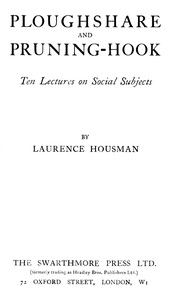
Ploughshare and Pruning-Hook: Ten Lectures on Social Subjects — Key Ideas to Explore
(0 User reviews)
792
Project Gutenberg
2021
Not confirmed
Social sciences; Social ethics
Readers of public-domain and historical texts
Project Gutenberg digital edition
en
Edition facts
Words
65,843
Reading time
287 min
Text sections
6
Ploughshare and Pruning-Hook: Ten Lectures on Social Subjects — Key Ideas to Explore can be approached with a clearer sense of reading commitment from its source measurements: 65,843 words, 4 hr 47 min estimated reading time, and 6 detected text sections.
The text analysis averages about 34.2 words per sentence, while the detected sections provide another way to judge how the source is divided.
Project Gutenberg metadata also associates the work with “Social sciences,” connecting these edition facts with the source record’s subject description.
Source:
Project Gutenberg record #66101
An editorial note on Laurence Housman's 1919 lecture collection, examining his rhetorical strategies, use of paradox, and the tension between pulpit and platform in his social criticism.
Read the complete public-domain text at its original source.
Read on Project GutenbergLaurence Housman opens his preface with a disarmingly modest claim: these ten lectures 'make no pretence to the solution of the social or political problems with which they are concerned.' Instead, they aim to indicate 'a certain standpoint or attitude of mind.' This framing is characteristic of the authorial voice throughout—one that combines self-deprecation with a sharp, often provocative edge. Housman notes that the lectures were given in both pulpit and platform settings, and that their 'occasional tendency to make the congregation laugh' was seen by some as a drawback. This tension between seriousness and wit, between religious and secular audiences, becomes a central stylistic feature of the work.
The Preacher's Licence and the Platform's Rebuttal
Housman draws a pointed contrast between the pulpit and the platform. In a church, he observes, a preacher is 'immune from interjection or debate,' which can foster a 'complacency which is not always intellectually justified.' He recalls that two of these lectures, after being accepted in a church with only 'momentary breaches of decorum,' provoked elsewhere 'a storm of criticism and rebuke.' This anecdote serves as a concrete example of how the same words land differently depending on the setting. Housman uses this to question why 'conversion'—change of heart—is central to religious appeal but hardly reckoned with on the political platform. The distinction is not merely contextual; it reveals a deeper assumption about human nature and the possibility of moral change.
The Paradox of Lawbreaking and Moral Progress
One of Housman's most striking rhetorical moves is his defense of lawbreaking as a catalyst for moral change. He quotes a 'wise magistrate' who said, 'Bad laws have to be broken before they can be mended.' But Housman adds a crucial qualification: to be broken with good effect, they must be broken 'not by the criminal classes but by the martyrs and the reformers.' This distinction is central to his argument. He then makes a sweeping historical claim: 'every great moral change in history has been brought about by lawbreakers and by resistance to authority.' The examples he offers—English Nonconformists fighting governments—are chosen to illustrate that even 'egregious and even pernicious' doctrines can serve a just principle. The principle, for Housman, is the freedom of the spirit to take its chance 'in contact with the life material.'
The Credibility of Institutions and the Individual Conscience
Housman is particularly scathing about institutions that betray their own professed standards. He describes a political world in 'so discreditable a condition' that a candidate who cheated his opponent was 'successfully prevented from re-entering Parliament even to this day.' The point is not the specific case but the pattern: 'great organisations and great institutions thus discrediting themselves by conniving at the double-dealings of those whom they would place or keep in authority.' When this happens, Housman argues, the 'honestly critical observer' cannot place their judgment above his own. The sanction of a community false to its professions is 'nil.' This leads to a forceful assertion of individual conscience as a 'resistant irrespective of the weight of numbers against it.'
Majority Rule and the Duty of Resistance
Housman is no uncritical democrat. He declares himself 'not myself greatly enamoured of majority rule in the sense of a majority exercising compulsion on a minority.' Compulsion by a majority, he writes, 'I should often think it a duty to resist.' Yet he distinguishes this from the 'testimony of a majority that refrained from compulsion,' to which he would attach great weight. This nuanced position reflects his broader concern with the conditions under which authority is legitimate. He insists that a state based on democratic principles must trust its community to choose what it thinks good, and that refusing 'to the general community the means of deciding for itself by the utmost freedom of discussion' is 'the most discreditable conduct imaginable.' The argument is consistently grounded in the relationship between individual judgment and collective decision-making.
Housman's lectures are best approached as exercises in moral rhetoric rather than systematic treatises. He is less concerned with policy prescriptions than with unsettling complacent assumptions about authority, progress, and the role of the individual. Readers will find that his arguments often proceed by paradox and provocation, and that his examples—drawn from politics, religion, and history—are chosen for their illustrative force rather than their completeness. The value of the collection lies not in any single thesis but in the persistent, questioning stance it models.
There’s something about Housman’s quiet insistence on dismantling comfortable certainties that lingers. It reminded me of another voice, one I once returned to on a grey afternoon, which also wrestled with revaluation, though from a starker, more solitary angle. That old copy of The Will to Power: An Attempted Transvaluation of All Values. Book III and IV — Themes and Context felt like a darker echo, a shadow stretching longer than the lecture room’s. Both, I think, were lonely efforts to find a new ground.
There are no reviews for this eBook.
There are no comments for this eBook.
Reader reflection
Your personal reading reflection
Build a private reading journal entry for this title.
Your progress
0
/
10
2
Did this book hold your interest?
3
Would you recommend this book to another reader?
4
How demanding did the text feel?
5
How strongly did the book affect you emotionally?
6
What did you appreciate most?
7
Did the book deliver what you hoped for?
8
Was the book easy to understand?
9
In one sentence, what did you learn?
10