1

Selections from the Writings of Kierkegaard — Context and Discussion
(0 User reviews)
860
Project Gutenberg
2019
Not confirmed
Theology; Philosophy
Readers of public-domain and historical texts
Project Gutenberg digital edition
en
Edition facts
Words
88,880
Reading time
387 min
Text sections
8
The source record for Selections from the Writings of Kierkegaard — Context and Discussion measures this digital text at 88,880 words, 6 hr 27 min estimated reading time, and 8 detected text sections.
The text analysis averages about 27.4 words per sentence, while the detected sections provide another way to judge how the source is divided.
Project Gutenberg metadata also associates the work with “Theology,” connecting these edition facts with the source record’s subject description.
Source:
Project Gutenberg record #60333
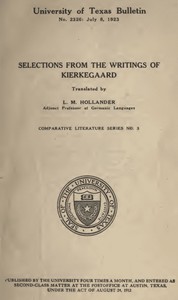
This 1923 translation by Lee M. Hollander collects five of Kierkegaard's key works, including 'Fear and Trembling' and 'The Present Moment.' The opening editorial introduction frames Kierkegaard as a corrective to materialist times, while the excerpts reveal his distinctive prose rhythms and relentless focus on faith, inwardness, and individual responsibility.
Read the complete public-domain text at its original source.
Read on Project GutenbergLee M. Hollander's 1923 translation presents Kierkegaard to an English audience as a thinker whose 'life is his works,' a claim the excerpts bear out through their intense, recursive prose. The editor's introduction positions Kierkegaard as an antidote to 'material considerations' and 'socializing' ideals, a framing that colors the selections that follow. Readers encounter a voice that circles its subjects—faith, doubt, Abraham—with relentless pressure, often repeating phrases like 'it is human to complain' or 'it is greater to believe' to hammer home distinctions between ordinary sorrow and the 'miracle of faith.'
A Voice of Repetition and Inwardness
The excerpts from Fear and Trembling display a distinctive rhetorical pattern: Kierkegaard builds paragraphs through parallel clauses that escalate rather than resolve. 'It is human to complain, it is human to weep with the weeping; but it is greater to believe'—such sentences do not argue so much as insist, creating a rhythm that mimics the labor of faith. The prose refuses to move quickly; it dwells, repeats, and reframes. This is not exposition but a kind of verbal enactment of inward struggle. Hollander's translation preserves the Latinate gravity ('steadfastly,' 'lamentation') that gives Kierkegaard's Danish a biblical weight. Readers should note how often the text returns to the same point from a slightly different angle, as if trying to wear down resistance through iteration.
Abraham as a Test Case for Faith
The treatment of Abraham in the Fear and Trembling excerpt is striking for what it does not do: it never narrates the Binding of Isaac. Instead, Kierkegaard dwells on the long wait for Isaac's birth, turning Abraham into a figure of 'steadfast' hope against all evidence. 'Abraham grew old, and Sarah became a laughing-stock to the people; and yet was he God's chosen.' The emphasis falls not on the dramatic moment but on the decades of ordinary, painful waiting. Kierkegaard contrasts Abraham with those who 'sorrow' or 'surrender hope,' insisting that faith means holding onto worldly hopes even after surrendering them. This paradoxical formulation—'greater still to abide steadfastly by one's worldly hopes after having surrendered them'—is central to the work's method: it defines faith not as belief in the miraculous but as a sustained orientation of the will.
The Editor's Framing and Its Limits
Hollander's introduction, written in 1923, presents Kierkegaard as a corrective to his own era's 'material considerations' and 'national ideals.' He cites Ibsen's Brand as indirectly indebted to Kierkegaard, and describes the Dane's life as 'notably poor in incidents' but rich in inward experience. This framing is itself a historical document: it reflects early twentieth-century anxieties about collectivism and secularism. Readers should be aware that the introduction's claims—that Kierkegaard is 'virtually unknown' to English readers, that his message is a 'bitter but wholesome antidote'—are part of the book's rhetorical strategy, not neutral description. The selections that follow may not fully bear out this framing; the excerpts focus on faith and doubt rather than social critique.
Reading the Selections as a Sequence
The collection includes five works: 'Diapsalmata,' 'In Vino Veritas (The Banquet),' Fear and Trembling, 'Preparation for a Christian Life,' and 'The Present Moment.' Based on the excerpts, the sequence moves from aesthetic fragments to ethical-religious reflection. 'Diapsalmata' likely offers aphoristic, ironic pieces; 'In Vino Veritas' is a symposium-style dialogue; Fear and Trembling presents the pseudonymous Johannes de Silentio's meditation on Abraham; the later works shift toward explicitly Christian themes. Readers may find it useful to treat the collection as a staged progression, with each section complicating the previous one. The editor's introduction warns that Kierkegaard's works form a 'literature within a literature,' suggesting that the selections are meant to be read as interconnected, not as standalone essays.
This edition rewards readers who attend to the texture of the prose—its repetitions, its paradoxes, its refusal to settle into easy conclusions. The excerpts from Fear and Trembling in particular demonstrate how Kierkegaard uses syntax to perform the mental labor of faith. Hollander's translation, though dated, captures the gravity of the original. Approach the collection not as a systematic philosophy but as a series of experiments in making the reader feel the weight of inwardness.
That gray afternoon, Hollander’s Kierkegaard kept circling back to the cost of conviction, the lonely weight of a “yes” spoken against the crowd. I set it down, rain tapping the sill, and found myself pulling out The Bloudy Tenent of Persecution for Cause of Conscience Discussed and Mr. Cotton's Letter Examined and Answered — A Closer Reading—another voice, three centuries older, arguing the same fierce tenderness for individual conscience against the machinery of certainty.
There are no reviews for this eBook.
There are no comments for this eBook.
Reader reflection
Your personal reading reflection
Build a private reading journal entry for this title.
Your progress
0
/
10
2
Was reading this book enjoyable?
3
Would you encourage someone else to read it?
4
How demanding did the text feel?
5
Would this book work well in a reading group?
6
How would you rate its originality?
7
How clear did the writing feel?
8
Would you read this book again?
9
What changed or sharpened your thinking?
10