1

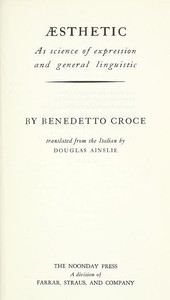
Æsthetic as science of expression and general linguistic — Story, Setting & Ideas
(0 User reviews)
445
Project Gutenberg
2017
Not confirmed
Philosophy; Aesthetics; Language and languages -- Philosophy
Readers of public-domain and historical texts
Project Gutenberg digital edition
en
Edition facts
Words
174,386
Reading time
759 min
Text sections
36
For Æsthetic as science of expression and general linguistic — Story, Setting & Ideas, the stored edition analysis reports 174,386 words, 12 hr 39 min estimated reading time, and 36 detected text sections.
The text analysis averages about 23.9 words per sentence, while the detected sections provide another way to judge how the source is divided.
Project Gutenberg metadata also associates the work with “Philosophy,” connecting these edition facts with the source record’s subject description.
Source:
Project Gutenberg record #54618
Croce argues that aesthetic intuition is identical with expression, grounding art in a universal linguistic activity. This translation by Douglas Ainslie presents the second edition of the first volume of Croce's Philosophy of the Spirit, with extensive historical references.
Read the complete public-domain text at its original source.
Read on Project GutenbergBenedetto Croce opens his treatise by asserting that intuitive knowledge is independent of intellectual knowledge, a claim he defends through a series of precise distinctions: intuition is not perception, not sensation, not association, and not representation—it is, finally, expression. This initial chapter, titled "Intuition and Expression," establishes the foundational identity that drives the entire work: intuition and expression are one and the same. The argument proceeds by negation, eliminating rival conceptions before arriving at its positive thesis. Croce's prose is systematic, almost syllogistic, as he builds a philosophical architecture meant to encompass both art and language under a single principle.
The Identity of Intuition and Expression
Croce's central claim is that every genuine intuition is also an expression. He rejects the notion that we can have an intuition without expressing it, whether in words, lines, or sounds. This is not a psychological claim about the necessity of outward manifestation but a philosophical one about the nature of intuition itself: to intuit is to shape a content into a form, and that shaping is expression. The argument is made through a series of corollaries and explanations in Chapter II, where he denies any specific difference between art and intuitive knowledge. Art, for Croce, is not a special kind of intuition but simply intuition in its fullest sense. He criticizes theories that posit a difference of intensity or that separate content from form, insisting that the work of art is an indivisible unity. The reader should note how Croce's method is to define by exclusion: he systematically eliminates what intuition is not before affirming what it is.
The Pace of Philosophical Argument
The treatise moves at a deliberate, almost legalistic pace. Croce presents a thesis, anticipates objections, and refutes them with numbered criticisms. For instance, in Chapter III, "Art and Philosophy," he argues for the inseparability of intellectual from intuitive knowledge while maintaining their distinctness. The rhythm is one of assertion, clarification, and polemic. Croce frequently engages with historical figures—Baumgarten, Herder, Kant—but always to sharpen his own position. The translator, Douglas Ainslie, preserves this measured tone, though the reader may notice occasional shifts in sentence length as Croce moves from dense definition to broader historical survey. The later chapters, such as those on "Historicism and Intellectualism in Æsthetic," accelerate into a critique of entire schools of thought, listing errors and their consequences with a cumulative force.
Language as the Key to Æsthetic
The subtitle of the work—"as science of expression and general linguistic"—signals Croce's ambition to unify aesthetics and linguistics. In the excerpts, this theme emerges through his engagement with eighteenth-century theorists of language, such as Du Marsais, Condillac, and Cesarotti. Croce treats language not as a separate faculty but as the very activity of expression that constitutes art. The footnotes and references to works on the origin of language (e.g., Monboddo, Süssmilch) indicate that he is intervening in a contemporary debate. For Croce, the philosophy of language is not ancillary to aesthetics; it is its foundation. The reader should attend to how Croce uses historical sources not as mere citations but as foils for his own theory. His method is to extract a core insight from each thinker and then show how it is incomplete without his own principle of intuition-expression.
Croce's Æsthetic is a work that demands careful reading: its arguments are tightly woven, and its conclusions depend on precise definitions. The reader may find it helpful to track the key terms—intuition, expression, concept, art—as they are refined across chapters. The second edition includes an extensive historical appendix that situates Croce's thought within the tradition of aesthetic theory from Baumgarten to the late nineteenth century. This editorial note is based solely on the excerpts provided; the full work may develop arguments not visible here.
That afternoon the rain kept time against the glass while Croce’s claim—that expression is the very act of knowing—settled in me, quietly loosening my own tangled thoughts. Later, thumbing the shelf, I found Nietzsche’s harsh, brilliant voice waiting, as if answering that same unease from another room. The Genealogy of Morals The Complete Works, Volume Thirteen, edited by Dr. Oscar Levy. — Reading Notes felt less like a departure than a continuation—a shadow cast by the same light.
There are no reviews for this eBook.
There are no comments for this eBook.
Reader reflection
How did this book work for you?
Your answers remain private and are stored only in this browser.
Your progress
0
/
10
2
How did the book work for you overall?
3
Would you pass this book on to a friend?
4
How easy was the book to follow?
5
What did you appreciate most?
6
How much did the book move you?
7
Would you start a conversation about this book?
8
How closely did the book connect with your experience?
9
What did this book teach you most?
10