1

The Genealogy of Morals The Complete Works, Volume Thirteen, edited by Dr. Oscar Levy. — Reading Notes
(0 User reviews)
72
Project Gutenberg
2016
Not confirmed
Ethics
Readers of public-domain and historical texts
Project Gutenberg digital edition
en
Edition facts
Words
59,388
Reading time
259 min
Text sections
5
Before opening The Genealogy of Morals The Complete Works, Volume Thirteen, edited by Dr. Oscar Levy. — Reading Notes, the edition data offers a quick orientation: 59,388 words, 4 hr 19 min estimated reading time, and 5 detected text sections.
The text analysis averages about 35.8 words per sentence, while the detected sections provide another way to judge how the source is divided.
Project Gutenberg metadata also associates the work with “Ethics,” connecting these edition facts with the source record’s subject description.
Source:
Project Gutenberg record #52319
This editorial note examines how Nietzsche's preface, first essay, and later passages on Wagner guide a first reading of The Genealogy of Morals, focusing on the author's self-awareness, analytical method, and rhetorical shifts.
Read the complete public-domain text at its original source.
Read on Project GutenbergNietzsche opens the preface with a striking confession: “We are unknown, we knowers, ourselves to ourselves.” This admission of self-ignorance sets the tone for a work that will probe the origins of moral values while questioning the very motives of those who seek knowledge. The preface establishes a metaphor of the knower as a “honey-gatherer of the spirit,” always striving to bring something “home to the hive.” Yet Nietzsche warns that we remain strangers to ourselves, counting wrong the beats of our own experience. This tension between the drive for knowledge and the opacity of the self is the engine that drives the three essays that follow.
The Knower as Stranger
The preface’s opening lines immediately challenge the reader: if we knowers do not know ourselves, how can we trust our moral inquiries? Nietzsche uses the image of a clock striking twelve noon to illustrate how we belatedly ask, “Through what have we in point of fact just lived?” This rhetorical device—posing a question and then deflecting it—recurs throughout the work. The preface also introduces the motif of the “hive,” suggesting that knowledge is a form of accumulation, but one that may obscure rather than reveal. Readers should note how Nietzsche positions himself as both the investigator and the object of investigation, a dual role that complicates every subsequent argument.
The First Essay’s Polemical Structure
The first essay, titled “Good and Evil,” “Good and Bad,” immediately signals Nietzsche’s method: he will dismantle binary oppositions by tracing their historical development. The essay is not a systematic treatise but a series of aphoristic thrusts, each building on the last. Nietzsche contrasts the master morality of the “noble” with the slave morality of the “weak,” but he does so through a genealogy that is as much rhetorical as historical. Key phrases such as “the priestly mode of valuation” and “the slave revolt in morals” appear early, setting up the conflict that will occupy the entire book. Readers should pay attention to how Nietzsche uses italics and exclamation marks to mimic the voice of his opponents, a technique that makes the text feel like a live debate.
The Ascetic Ideal and Wagner’s Turn
In the third essay, Nietzsche turns to the ascetic ideal, using Richard Wagner’s later works as a case study. He asks, “What is the meaning of an artist veering round into his own opposite?” referring to Wagner’s shift toward asceticism and Christianity. Nietzsche speculates that Wagner’s Parsifal might be a “secret laugh of superiority over himself,” a parody of the tragic. This passage is crucial because it shows Nietzsche applying his genealogical method to a contemporary figure, testing his theory against a living example. The discussion of chastity versus sensuality, with references to Goethe and Hafiz, illustrates Nietzsche’s preference for a “delicate balance” over tragic conflict. Readers should note how Nietzsche’s tone shifts from analytical to almost playful, especially when he imagines Wagner’s “Luther Comedy.”
Editorial Framing and Translation Choices
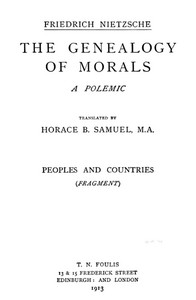
The Project Gutenberg edition includes an editor’s note by Dr. Oscar Levy, who describes The Genealogy of Morals as “perhaps the least aphoristic, in form, of all Nietzsche’s productions” and praises its “analytical power” regarding the ascetic ideal. This note, written in 1913, reflects the early reception of Nietzsche in English. The translation by Horace B. Samuel and J. M. Kennedy preserves Nietzsche’s emphatic punctuation and sentence fragments, which can be disorienting. Readers should be aware that the text includes a fragment titled “Peoples and Countries” translated by Kennedy, which is not part of the original three essays. This appendix offers a different, more geographical perspective on Nietzsche’s thought.
Approaching The Genealogy of Morals as a first-time reader, it helps to treat each essay as a self-contained polemic that nevertheless builds on the previous one. The preface’s warning—that we are strangers to ourselves—should be kept in mind when Nietzsche makes sweeping claims about history, psychology, and art. His use of rhetorical questions, imagined dialogues, and sudden shifts in tone are not flaws but deliberate strategies to unsettle the reader. Pay attention to the moments when Nietzsche seems to contradict himself or laugh at his own seriousness; these are often where his most incisive insights lie.
Sitting with those Nietzsche reading notes, I felt the familiar ache of a thinker dismantling his own certainties. It reminded me of another quiet companion who wrestled with the same restless inwardness, though he spoke in a different tongue. There is a strange comfort in their shared struggle, a gentleness beneath the sharp edges. Selections from the Writings of Kierkegaard — Context and Discussion holds that same hushed, personal urgency, as if written for no one but the reader who happens upon it.
There are no reviews for this eBook.
There are no comments for this eBook.
Reader reflection
How will you remember this book?
Save your reaction, strongest insight, and memorable passage.
Your progress
0
/
10
2
How did the book work for you overall?
3
How likely are you to recommend this book?
4
How demanding did the text feel?
5
How understandable was the text?
6
Was the book moving at the right speed?
7
How distinctive were its ideas or approach?
8
Would this book work well in a reading group?
9
What did this book teach you most?
10