1

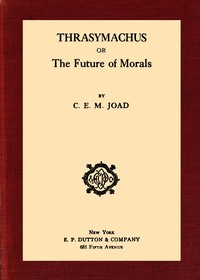
Thrasymachus — Reading Companion
(0 User reviews)
2339
Project Gutenberg
2024
Not confirmed
Ethics
Readers of public-domain and historical texts
Project Gutenberg digital edition
en
Edition facts
Words
21,817
Reading time
95 min
Text sections
6
For Thrasymachus — Reading Companion, the stored edition analysis reports 21,817 words, 1 hr 35 min estimated reading time, and 6 detected text sections.
The text analysis averages about 25.9 words per sentence, while the detected sections provide another way to judge how the source is divided.
Project Gutenberg metadata also associates the work with “Ethics,” connecting these edition facts with the source record’s subject description.
Source:
Project Gutenberg record #74315
C. E. M. Joad revives the Sophist Thrasymachus to argue that morality is a tool of the powerful, applying this lens to early 20th-century debates on birth control, sexual morality, and class. The opening frames Plato's dialogue, while later excerpts apply the thesis to contemporary social issues.
Read the complete public-domain text at its original source.
Read on Project GutenbergThe book opens by revisiting Thrasymachus, the blustering figure from Plato's Republic who defines justice as “the interest of the stronger.” Joad immediately notes that Plato’s portrayal—Thrasymachus as an offensive, long-winded speaker—may be a dramatic trick to discredit an uncomfortable idea. The author then extracts the core argument: rulers make laws to serve their own interests, and morality is merely obedience to those laws. This sets up a sustained critique of conventional ethics, which Joad traces through the social contract tradition from Hobbes onward.
Plato’s Dramatic Trick and the Core Thesis
Joad begins by analyzing Plato’s method. Thrasymachus is “a blustering, overbearing personage” who makes long speeches and, when cornered, accuses Socrates of having a cold. Joad calls this “an old one” that argues for Plato’s “sense of dramatic fitness.” Yet he insists the plausibility of Thrasymachus’s position should not be overlooked. The thesis—that justice is the interest of the stronger—is then unpacked: the stronger control government and laws, so obeying the law furthers their interests. Morality becomes a device for ensuring subservience. Joad links this to the social contract theory, citing Hobbes’s description of the state of nature as “solitary, poor, nasty, brutish and short.” The implication is that human nature is fundamentally non-moral, and morality is an artificial imposition.
Herd Morality and the Tyranny of the Average
In later chapters, Joad extends the argument to what he calls “herd morality.” The herd—the average individual—enforces its prejudices by making life intolerable for those who flout them. This power depends on detection, which in sexual matters historically relied on the unavoidable consequence of children. Joad writes that “it is not easy to disguise the existence of a child,” and even infanticide presents “grave difficulties.” But birth control changes this: it “knocked the bottom out of what is called sexual morality.” By allowing people to “sin” without being found out, it undermines the herd’s ability to enforce its code. Joad notes that the lower classes, who are exhorted to choose continence or children, will eventually see the hypocrisy of their upper-class critics, who practice birth control while denouncing it.
Birth Control, Economic Independence, and the Double Standard
Joad argues that birth control, combined with women’s economic independence, brings a “new freedom.” Economic independence allows women to have children without marriage or the workhouse; birth control makes it unnecessary to have children at all. He then addresses the double standard of marital fidelity: adultery in a wife is a sufficient cause for divorce, while in a husband it must be coupled with cruelty or desertion. The reason, Joad claims, is economic: a wife’s children become a charge on the husband. The disparity “has always caused grave offence to feminist organizations,” but Joad presents it as a logical outcome of dependency. With birth control and economic independence, this double standard is likely to be abolished.
The Coming Clash: Individual Liberty vs. Herd Control
The final chapter, “The Coming Clash,” is not excerpted, but the trajectory is clear. Joad’s argument moves from abstract theory to concrete social prediction. The excerpts show a pattern: each application of the Thrasymachean thesis—to morality, to sexual norms, to class—leads to a forecast of change. Birth control is “bound in course of time to percolate through every social stratum.” The lower classes will draw the “inevitable inference” about the hypocrisy of their betters. The result is a “rapidly deteriorating population” if the upper classes continue to limit their numbers while the lower classes proliferate. Joad’s tone is analytical, even clinical, but the underlying polemic is clear: the herd’s moral power is eroding, and a clash between individual liberty and herd control is imminent.
Readers should note that Joad’s argument is not a neutral survey but a sustained polemic. The excerpts reveal a writer who uses classical philosophy as a springboard for contemporary social criticism. The book’s structure—from Plato to birth control—mirrors its thesis: morality is always the interest of the stronger, whether the stronger is a tyrant or the average man. Pay attention to how Joad shifts between historical analysis and direct commentary on 1920s debates; this movement is central to his method.
I remember sitting with this companion in a quiet library, unsettled by how easily power wears morality like a cloak. It stirred the same ache I felt years ago with Lysistrata — Context and Discussion, where the women’s strike exposed the flimsy rules men called natural. Both books left me wondering whose comfort our values truly protect.
There are no reviews for this eBook.
There are no comments for this eBook.
Reader reflection
How will you remember this book?
Save your reaction, strongest insight, and memorable passage.
Your progress
0
/
10
2
What was your overall reaction to the book?
3
Is this a title you would suggest to others?
4
Did the language feel accessible?
5
How strongly did the book affect you emotionally?
6
How would you rate its originality?
7
How personally connected did you feel to the book?
8
How useful did the reading feel?
9
Which lesson or insight stayed with you?
10