1

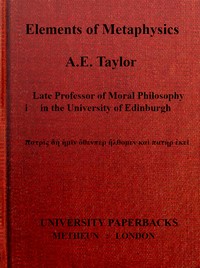
Elements of metaphysics — Context and Discussion
(0 User reviews)
157
Project Gutenberg
2023
Not confirmed
Metaphysics
Readers of public-domain and historical texts
Project Gutenberg digital edition
en
Edition facts
Words
192,664
Reading time
838 min
Text sections
26
For Elements of metaphysics — Context and Discussion, the stored edition analysis reports 192,664 words, 13 hr 58 min estimated reading time, and 26 detected text sections.
The text analysis averages about 28.3 words per sentence, while the detected sections provide another way to judge how the source is divided.
Project Gutenberg metadata also associates the work with “Metaphysics,” connecting these edition facts with the source record’s subject description.
Source:
Project Gutenberg record #71885
A. E. Taylor's 1903 metaphysics textbook systematically examines the nature of reality, arguing against subjective idealism by grounding independent existence in social experience and purposive action.
Read the complete public-domain text at its original source.
Read on Project GutenbergA. E. Taylor's Elements of Metaphysics (1903) opens with a dedication to F. H. Bradley and a preface acknowledging debts to Bradley, Royce, Ward, Stout, Avenarius, and Münsterberg. The work is a systematic treatise, not a collection of essays, and it explicitly aims to guide further study rather than to represent any single school. The excerpts reveal a sustained argument against what Taylor calls 'mere Subjectivism or Presentationism,' contending that physical existence cannot be reduced to sense-perception alone. Instead, he builds a case that the reality of unperceived objects is required to make sense of our own inner life and purposive behavior.
The Social Origin of Independent Existence
Taylor argues that the concept of 'independent' existence originates from our experience of other people. In the excerpts, he states that the 'independent existence' of fellow humans means 'existence as centres of experience, as feeling, purposive beings.' This social model is then extended to the rest of the physical order. He claims that the grounds for ascribing independent existence to physical objects are 'essentially of the same kind' as those for other persons. This move is central to his rebuttal of subjective idealism: if we accept that other minds exist beyond our perceptions, consistency demands that we grant similar status to the non-human world. Taylor thus ties metaphysics to social epistemology, a distinctive approach in early twentieth-century British philosophy.
Against Presentationism: The Argument from Evolution
Taylor deploys a striking argument against any idealism that reduces reality to mere presentations. He contends that if human life is part of a 'great system characterised by evolution or development,' then treating earlier stages of that development as mere 'presentation-complexes' would be incoherent. He writes that such a view 'reduces evolution to a dream, and must therefore be false.' This argument leverages the scientific standing of evolutionary theory to challenge subjectivist metaphysics. Taylor does not deny that some appearances may be hallucinatory—he acknowledges that 'what appears to us as an element in the physical order may sometimes have no reality beyond the fact of its appearance'—but insists that the very possibility of distinguishing illusion from reality presupposes a broader framework in which physical existence is more than a collective hallucination.
The Role of Practical Ends in Metaphysical Proof
A notable feature of Taylor's method is his appeal to practical agency. He argues that we must recognize unperceived physical existence because 'my own inner life is unintelligible without reference to it.' To achieve our practical ends, we must take account of factors in our material environment 'precisely as we have to take note of the purposive behaviour not our own which forms our social environment.' This pragmatic thread connects metaphysical necessity to the conditions of action. Taylor also invokes the sciences—geography, climate, economics—as domains where reference to non-presented reality is unavoidable. The excerpts thus show a philosopher who, while engaging with idealist traditions, grounds his arguments in the concrete demands of human life and scientific practice.
Readers approaching Elements of Metaphysics should note that Taylor's arguments are developed through close reasoning rather than historical survey. The excerpts show a writer who engages critically with idealism while drawing on pragmatist and scientific themes. Those interested in the intersection of metaphysics, epistemology, and the philosophy of mind will find Taylor's social account of independent existence a distinctive contribution. The text rewards careful attention to how Taylor builds his case step by step, often anticipating objections and refining his positions.
Reading Taylor’s insistence that reality resists us through action, I remembered evenings spent underlining Elements of Metaphysics, feeling the weight of his argument settle like dusk. That same quiet certainty returned later, late at night, annotating Issues in Population and Bioethics — Reading Notes. Both books asked me to trust what pushes back—against my wishes, against my logic—and call it real.
There are no reviews for this eBook.
There are no comments for this eBook.
Reader reflection
What did you think of this book?
Answer a few questions and save a private reflection on this device.
Your progress
0
/
10
2
Did this book hold your interest?
3
Would you encourage someone else to read it?
4
How demanding did the text feel?
5
Did you relate to its people, ideas, or situations?
6
Did this book create an emotional response?
7
How useful did the reading feel?
8
Is this a title worth rereading?
9
What is the main idea you are taking away?
10