1

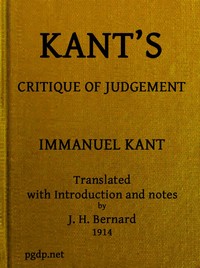
Kant's Critique of Judgement — Text and Context
(0 User reviews)
544
Project Gutenberg
2015
Not confirmed
Judgment (Logic); Judgment (Aesthetics); Teleology
Readers of public-domain and historical texts
Project Gutenberg digital edition
en
Edition facts
Words
138,535
Reading time
603 min
Text sections
25
For Kant's Critique of Judgement — Text and Context, the stored edition analysis reports 138,535 words, 10 hr 3 min estimated reading time, and 25 detected text sections.
The text analysis averages about 32.2 words per sentence, while the detected sections provide another way to judge how the source is divided.
Project Gutenberg metadata also associates the work with “Judgment (Logic),” connecting these edition facts with the source record’s subject description.
Source:
Project Gutenberg record #48433
This editorial note examines J. H. Bernard's 1914 translation of Kant's Critique of Judgement, focusing on authorial choices in diction, dialogue, and description. It highlights Kant's precise terminology, the translator's rendering of key concepts, and the structural interplay between aesthetic and teleological judgment.
Read the complete public-domain text at its original source.
Read on Project GutenbergJ. H. Bernard's 1914 translation of Kant's Critique of Judgement presents a careful lexical architecture. Kant's original German terms—such as Zweckmässigkeit (purposiveness) and Urteilskraft (judgement)—are rendered with deliberate consistency, shaping the reader's encounter with the text. Bernard's choice of 'purposiveness' over 'finality' or 'teleology' signals a commitment to Kant's systematic framework, where the concept bridges nature and freedom. The translator's introduction and footnotes further reveal his interpretive stance, often clarifying Kant's dense prose without oversimplifying.
Diction and the Architecture of Concepts
Kant's vocabulary in the Critique of Judgement is meticulously layered. Terms like 'aesthetical' (not 'aesthetic') and 'judgement' (with the older spelling) are retained by Bernard, preserving the 18th-century philosophical context. The word 'disinterested' in §2—'The satisfaction which determines the judgement of taste is disinterested'—carries a specific technical weight, distinguishing aesthetic pleasure from mere agreeableness or moral approval. Bernard's translation of interesselos as 'disinterested' avoids the modern connotation of boredom, instead pointing to a freedom from personal inclination. Similarly, 'purposiveness without purpose' (Zweckmässigkeit ohne Zweck) is rendered with a hyphenated precision that underscores Kant's paradox: the form of an object appears designed yet serves no determinate end.
Voice and the Rhetoric of System
Kant's authorial voice is impersonal yet authoritative, employing a systematic structure of numbered sections and moments. The Critique of Judgement is divided into two parts—the Critique of Aesthetical Judgement and the Critique of Teleological Judgement—each with its own analytic and dialectic. This architecture mirrors Kant's broader critical project, where each faculty (Understanding, Judgement, Reason) is examined in turn. Bernard's translation preserves the formal tone, with sentences that often unfold through nested clauses and qualifications. For instance, in §9, Kant asks 'whether in a judgement of taste the feeling of pleasure precedes or follows the judging of the object'—a question that drives the analytic forward. The translator's notes occasionally intervene to explain Kant's references to earlier works, such as the Critique of Pure Reason, helping readers trace the argument's lineage.
Description and the Sensible in the Text
Despite its abstract subject, the Critique of Judgement contains vivid descriptive passages, particularly in the 'Analytic of the Sublime' and the discussion of fine art. Kant contrasts the 'free play' of imagination in aesthetic judgment with the 'mechanical' regularity of nature. In the excerpt on music, he writes that 'every expression of speech has in its context a tone appropriate to the sense,' linking sound to affection. Bernard's translation captures this sensory dimension: 'the art of tone employs it by itself alone in its full force, viz. as a language of the affections.' The description of music as 'a kind of mechanical association' and its effect as 'transitory' reveals Kant's ambivalence—valuing poetry above music for its 'honesty and candour.' These passages ground Kant's theory in concrete examples, from architecture to bird song, making the abstract argument tangible.
Structure and the Interplay of Faculties
The Critique of Judgement is structured as a bridge between the Critique of Pure Reason (which deals with nature) and the Critique of Practical Reason (which deals with freedom). Kant introduces Judgement as a faculty that mediates between Understanding and Reason, with its own a priori principle: purposiveness. The book's division into two parts reflects this dual role: the aesthetic judgment concerns the subjective feeling of pleasure, while the teleological judgment concerns the objective concept of natural ends. Bernard's translation highlights this structural symmetry through consistent section headings and cross-references. The 'Introduction' outlines the division of philosophy into theoretical and practical, with Judgement as the 'means of combining the two parts into a whole.' This architectural clarity is essential for navigating Kant's argument, as each section builds on the previous one.
Readers approaching this translation should attend to Bernard's footnotes, which often clarify Kant's references and terminology. The text rewards slow reading, especially in the 'Analytic of the Beautiful,' where each 'moment' of taste is dissected. Comparing Bernard's rendering with other translations (e.g., Meredith's) can illuminate the choices involved in conveying Kant's thought. The Critique of Judgement remains a demanding but rewarding work, and this edition provides a reliable entry point for studying Kant's aesthetics and teleology.
Some books sit with you like a held breath, and this edition of Kant’s Critique of Judgement felt that way—his careful weighing of every word, the translator’s quiet choices. It reminded me of an old friend, A Logic of Facts; Or, Every-day Reasoning — A Reader’s Guide, which lingers with the same gentle insistence on how we actually think, not how we’re told to. Both feel like conversations you’d continue alone.
There are no reviews for this eBook.
There are no comments for this eBook.
Reader reflection
Your personal reading reflection
Build a private reading journal entry for this title.
Your progress
0
/
10
2
How did the book work for you overall?
3
Would you pass this book on to a friend?
4
How much effort did this book require?
5
How would you describe its reading pace?
6
Was the book what you thought it would be?
7
Did this book create an emotional response?
8
Would this book work well in a reading group?
9
Which lesson or insight stayed with you?
10