1

The Logic of Hegel — A Reader’s Guide
(0 User reviews)
405
Project Gutenberg
2017
Not confirmed
Logic
Readers of public-domain and historical texts
Project Gutenberg digital edition
en
Edition facts
Words
156,392
Reading time
680 min
Text sections
17
This digital edition of The Logic of Hegel — A Reader’s Guide is described by source-level measurements including 156,392 words, 11 hr 20 min estimated reading time, and 17 detected text sections.
The text analysis averages about 23.0 words per sentence, while the detected sections provide another way to judge how the source is divided.
Project Gutenberg metadata also associates the work with “Logic,” connecting these edition facts with the source record’s subject description.
Source:
Project Gutenberg record #55108
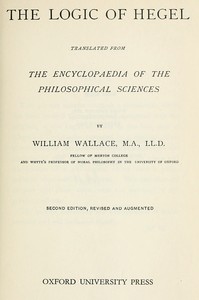
William Wallace's 1892 translation of Hegel's Encyclopaedia Logic, with a focus on the work's tripartite structure (Being, Essence, Notion) and Hegel's method of moving through opposed determinations. The excerpts show Hegel's characteristic use of polarity, identity, and difference, as seen in his discussion of the maxim of excluded middle and the example of +W and -W representing six miles West and East.
Read the complete public-domain text at its original source.
Read on Project GutenbergHegel's Logic, as presented in this translation by William Wallace, is built on a triadic structure that moves through the doctrines of Being, Essence, and the Notion. The excerpts reveal a text that proceeds by examining opposed determinations—such as identity and difference, positive and negative—and then showing how they are internally related. For instance, in the discussion of the maxim of excluded middle, Hegel argues that the statement 'A must be either +A or -A' implicitly posits a third term that is neither nor both, yet carries both characters. He illustrates this with the example of +W meaning six miles West and -W meaning six miles East, where the six miles remain regardless of the opposition. This pattern of exposing the inadequacy of fixed oppositions and pointing to a higher unity is a recurring structural feature.
Triadic Division and the Encyclopaedia's Outline
The Logic is the first part of Hegel's Encyclopaedia of the Philosophical Sciences, and its division into three main sections—the Doctrine of Being, the Doctrine of Essence, and the Doctrine of the Notion—is announced in the table of contents. This triadic structure is not merely organizational but reflects Hegel's dialectical method, where each category is examined and shown to pass into its opposite, leading to a more comprehensive concept. The excerpts from the section on Essence, for example, show Hegel analyzing the concepts of identity, difference, and opposition, and then moving to the notion of ground. The reader should note how each section builds on the previous one, with the Doctrine of Essence presupposing the categories of Being and developing them further. Wallace's translation includes extensive notes that clarify Hegel's terminology and references, which can aid in following the argument.
Polarity and the Critique of Formal Logic
A striking feature of the excerpts is Hegel's engagement with traditional logical principles, such as the maxim of identity, the maxim of contradiction, and the maxim of excluded middle. He criticizes the understanding for setting these maxims in juxtaposition without comparing them, and he shows how they lead to contradictions when applied rigidly. For instance, he writes that the maxim of excluded middle 'virtually declares in these words a third A which is neither + nor —, and which at the same time is yet invested with + and — characters.' This critique is not merely negative; Hegel aims to show that a higher form of logic, one that incorporates contradiction as a driving force, is necessary. The concept of polarity, which he notes is 'dominant in physics,' is presented as containing a more correct definition of opposition. The reader will encounter many such examples where Hegel uses concrete illustrations—like the circle as a polygon with rectilineal sides—to challenge formal logical rules.
Recurring Images of Movement and Relation
Throughout the excerpts, Hegel employs a set of recurring images and phrases that emphasize relation and movement. Terms like 'self-relation,' 'relation to its other,' and 'the other's own other' appear repeatedly, indicating that concepts are not static but defined through their connections. The image of the 'circle' and 'centre and circumference' is used to illustrate how opposite determinations can be equally essential within a notion. Similarly, the example of 'six miles of way or space' remaining unchanged despite the opposition of West and East suggests a substrate that persists through difference. These images serve to make abstract logical relations more concrete and to reinforce Hegel's central claim that opposition is always internal to a concept. The reader should watch for how these images recur and evolve as the text progresses through different logical categories.
The Role of the Translator's Apparatus
William Wallace's translation includes a substantial apparatus: a bibliographical notice on the three editions of the Encyclopaedia, prefaces, and extensive notes that are 'philological rather than philosophical' in character. The notes, which follow the main text, provide commentary on Hegel's terminology, references to other philosophers, and textual variants. For example, the note on Chapter VIII likely discusses the terms 'positive' and 'negative' in the context of the excerpt. This apparatus is valuable for readers who wish to understand the historical and textual background of Hegel's work. However, the reader should be aware that Wallace's notes do not provide a philosophical interpretation; they are meant to clarify the text's language and sources. The translation itself is from the second edition (1892), revised and augmented, and represents a key moment in the Anglophone reception of Hegel's logic.
Readers approaching this translation should be prepared for a text that demands close attention to the movement of concepts rather than a linear exposition of fixed definitions. Hegel's method is to show how each category, when examined, leads to its opposite and then to a higher unity. The examples drawn from mathematics and physics—such as the circle and polarity—are not mere illustrations but integral to the argument. Wallace's edition, with its careful translation and scholarly notes, provides a reliable entry point into this demanding work, but the reader must be willing to follow Hegel's dialectical path step by step.
Reading the way Hegel holds Being and Nothing together, I remembered sitting with my father’s old logic books, the one about the pure concept somehow warming a cold afternoon. That feeling returned—not of answers, but of patient company. Logic as the Science of the Pure Concept — A Closer Reading lingered in me like that, a quiet echo of the same unhurried movement.
There are no reviews for this eBook.
There are no comments for this eBook.
Reader reflection
Your personal reading reflection
Build a private reading journal entry for this title.
Your progress
0
/
10
2
How did the book work for you overall?
3
Would you pass this book on to a friend?
4
Did the language feel accessible?
5
How clearly were the main ideas presented?
6
How personally connected did you feel to the book?
7
Do you expect to return to this book?
8
Did you gain anything practical from the text?
9
What changed or sharpened your thinking?
10