1

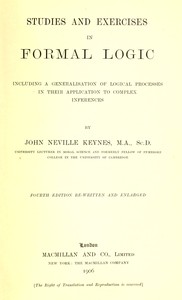
Studies and Exercises in Formal Logic — Inside the Classic
(0 User reviews)
94
Project Gutenberg
2019
Not confirmed
Logic
Readers of public-domain and historical texts
Project Gutenberg digital edition
en
Edition facts
Words
208,291
Reading time
906 min
Text sections
38
The source record for Studies and Exercises in Formal Logic — Inside the Classic measures this digital text at 208,291 words, 15 hr 6 min estimated reading time, and 38 detected text sections.
The text analysis averages about 23.7 words per sentence, while the detected sections provide another way to judge how the source is divided.
Project Gutenberg metadata also associates the work with “Logic,” connecting these edition facts with the source record’s subject description.
Source:
Project Gutenberg record #59590
Keynes's 1906 fourth edition systematically reworks traditional formal logic, emphasizing distinctions of modality, existential import, and the interplay between categorical and hypothetical propositions, with detailed exercises and theoretical refinements.
Read the complete public-domain text at its original source.
Read on Project GutenbergJohn Neville Keynes’s Studies and Exercises in Formal Logic, in its fourth edition (1906), is not a mere textbook but a sustained re-examination of logical fundamentals. The preface announces a new definition of “connotative name,” revised treatment of negative names, and a more detailed handling of modality and existential import. Keynes explicitly positions his work as a response to recent criticisms, particularly regarding the import of propositions, and acknowledges debts to Sigwart, J. S. Mackenzie, and W. E. Johnson. The book retains the traditional three-part structure—terms, propositions, syllogisms—while introducing a chapter on the characteristics of inference and an appendix on the fundamental laws of thought. Complex propositions, previously Part IV, are now relegated to an appendix, signaling a shift in pedagogical emphasis.
Modality and the Import of Propositions
Keynes devotes considerable attention to distinctions of modality, treating assertoric, problematic, and apodeictic propositions as more than mere variations in force. In the excerpts, he contrasts the assertoric interpretation of hypotheticals—where “If A then C” merely negatives the conjunction AC′—with the modal interpretation, which denies the possibility of that conjunction. This dual analysis recurs throughout: for example, the contrapositive of “If patience is a virtue, there are painful virtues” is given as “If there are no painful virtues, patience is not a virtue,” and Keynes notes that the equivalence holds on either interpretation. He also warns that converting “If A then C” to “If C then A” is a fallacy analogous to simply converting a categorical A proposition, calling it “perhaps the most dangerous fallacy to be guarded against in the use of hypotheticals.” The treatment of problematic hypotheticals extends the analogy with categoricals, showing that conversion and contraposition apply mutatis mutandis.
The Interplay of Categorical and Hypothetical Forms
A central tension in Keynes’s exposition is the relation between hypothetical and categorical propositions. He defines a true hypothetical as expressing a relation between two propositions of independent import, not between two terms, and insists that it is not easily reducible to categorical form. Yet he acknowledges that an equivalent categorical can sometimes be obtained, with subject and predicate drawn from the original clauses. This duality is explored through immediate inferences: obversion, conversion, contraposition, and inversion are applied to hypotheticals, often yielding results that mirror categorical logic but with important caveats. For instance, Keynes notes that from “If A then C” one may infer by inversion “It is possible for both A and C not to be true,” but only if the falsity of C is assumed possible. Such theoretical niceties, he admits, have little practical importance but raise problems of considerable theoretical interest.
Exercises and the Pedagogy of Formal Logic
The book’s subtitle promises “Studies and Exercises,” and the preface to the first edition (1884) states that the pages contain “a number of problems worked out in detail and unsolved problems, by means of which the student may test his command over logical processes.” The fourth edition retains this practical orientation while updating the theoretical framework. Keynes employs Euler’s diagrams for illustration, and the excerpts show worked examples of contraposition and conversion with both categorical and hypothetical propositions. The exercises are not mere drills; they are designed to expose common fallacies, such as the illicit conversion of hypotheticals or the inference from “If A then C” to “If A′ then C′.” By embedding exercises within a rigorous theoretical discussion, Keynes aims to cultivate not just technical skill but a deeper understanding of logical structure.
Readers approaching this edition should note that Keynes assumes familiarity with traditional syllogistic logic and uses it as a springboard for more nuanced analysis. The appendices—on fundamental laws of thought and complex propositions—are integral to his project, not afterthoughts. Pay close attention to the footnotes and cross-references, which often qualify or extend the main text. The exercises are best tackled after absorbing the corresponding theoretical sections, as they frequently test the very distinctions Keynes has just drawn.
This Keynes reminds me of sitting with my father's old logic primer, underlining margins just to feel the weight of argument settle. It stirred something gentler: how we classify not just thoughts but choices. Progressive Morality: An Essay in Ethics — Story, Setting & Ideas once gave me that same hush—where right and wrong felt less like rules, more like quiet, personal architecture.
There are no reviews for this eBook.
There are no comments for this eBook.
Reader reflection
Your personal reading reflection
Build a private reading journal entry for this title.
Your progress
0
/
10
2
How did the book work for you overall?
3
Would you pass this book on to a friend?
4
What was the reading difficulty like?
5
What did you think about the pace?
6
Did this book create an emotional response?
7
How distinctive were its ideas or approach?
8
Which aspect of the book did you value most?
9
In one sentence, what did you learn?
10