1

Novum organum — A Closer Reading
(0 User reviews)
1676
Project Gutenberg
2014
Not confirmed
Science -- Methodology -- Early works to 1800; Induction (Logic) -- Early works to 1800
Readers of public-domain and historical texts
Project Gutenberg digital edition
en
Edition facts
Words
94,639
Reading time
412 min
Text sections
9
The catalog record for Novum organum — A Closer Reading provides practical reading context through 94,639 words, 6 hr 52 min estimated reading time, and 9 detected text sections.
The text analysis averages about 35.7 words per sentence, while the detected sections provide another way to judge how the source is divided.
Project Gutenberg metadata also associates the work with “Science -- Methodology -- Early works to 1800,” connecting these edition facts with the source record’s subject description.
Source:
Project Gutenberg record #45988
Bacon's Novum Organum proposes a new method for interpreting nature, replacing Aristotelian logic with inductive reasoning based on sensory evidence. This edition, edited by Joseph Devey, includes the preface and early aphorisms outlining the 'solitary' and 'migrating' instances that guide scientific inquiry.
Read the complete public-domain text at its original source.
Read on Project GutenbergFrancis Bacon opens his Novum Organum by attacking both dogmatic philosophers who claim to have fully understood nature and skeptics who deny the possibility of knowledge. He advocates a middle path: testing ideas through experience rather than pure meditation. The work's title—'New Instrument'—signals a break from Aristotle's logical tools, proposing instead a method that begins with the senses and proceeds through carefully structured induction.
Bacon's preface sets the tone for a systematic overhaul of scientific reasoning. He criticizes earlier thinkers for either stifling inquiry with arrogant certainty or undermining it with despair. His own method, though 'difficult in operation,' aims to restore the senses to their proper role while rejecting the mind's untutored leaps. The excerpts show Bacon already distinguishing between types of evidence, such as 'solitary instances' that isolate a quality like color from other variables.
The Preface as Methodological Manifesto
Bacon's preface is not a mere introduction but a concentrated statement of his philosophical grievances and ambitions. He identifies two harmful extremes: those who 'dogmatize on nature' with professorial arrogance, and those who assert 'that nothing whatever can be known.' Both, he argues, have 'inflicted the greatest injury on philosophy and learning.' The first group corrupts inquiry by bringing others to their opinion; the second, though offering non-contemptible reasons, exceeds 'due moderation' and derives their view from 'not true sources.'
Bacon praises the more ancient Greeks for holding a 'prudent mean,' yet notes they relied solely on 'intense meditation' without a fixed rule. His own innovation is to establish a 'new and certain course for the mind' starting from 'the first actual perceptions of the senses.' He explicitly rejects the traditional use of logic as a late remedy, applied after the mind is already 'prepossessed with corrupted doctrines' and 'filled with the vainest idols.' This framing positions the Novum Organum as a preemptive tool, not a corrective for already flawed thinking.
Solitary and Migrating Instances: Bacon's Taxonomic Innovation
In the aphorisms, Bacon introduces a classification of 'prerogative instances' designed to accelerate and confirm inductive exclusion. Two types stand out in the excerpts: solitary instances and migrating instances. Solitary instances are those that exhibit a required nature in subjects with nothing else in common, or fail to exhibit it in subjects otherwise alike. For example, to investigate color, Bacon points to prisms and gems that yield colors 'not only internally but on the wall'—these share only color with fixed colors in flowers or metals. From such instances, he deduces that color is 'nothing but a modification of the image of the incident and absorbed light.'
Migrating instances track a nature as it comes into being or passes away. Bacon illustrates with whiteness: glass in its entire state versus powdered glass. The transition reveals that whiteness is conferred or removed by the change in texture. He warns, however, that such instances risk tying the form too closely to its efficient cause, 'which is never more than a vehicle or conveyance of the form.' Proper application of exclusion remedies this. These categories show Bacon's effort to systematize observation before leaping to axioms.
The Role of the Editor: Joseph Devey's Edition
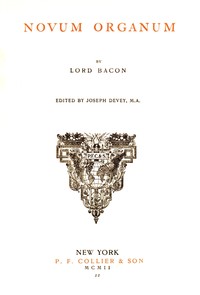
This Project Gutenberg edition reproduces the 1902 New York printing by P.F. Collier & Son, edited by Joseph Devey, M.A. Devey's editorial role is minimal in the excerpts—no footnotes or commentary appear—but his name on the title page signals a late-Victorian scholarly context. The text includes a transcriber's note about Greek transliteration, indicating that the original contained passages in Greek, though none appear in the provided excerpts. The edition's structure follows Bacon's own division into aphorisms, with the preface leading into numbered sections (e.g., XXII on solitary instances, XXIII on migrating instances).
Readers should note that the excerpts cover only the opening portions of a work that runs over 94,000 words. The full Novum Organum includes additional types of prerogative instances, a critique of the 'Idols of the Mind,' and a detailed plan for the 'Great Instauration.' Devey's edition presents Bacon's text without modern apparatus, making it a direct encounter with the original argument. The catalog subjects—'Science -- Methodology' and 'Induction (Logic)'—accurately reflect the work's core concerns, though the excerpts emphasize the methodological framework more than the logical theory.
Bacon's Novum Organum rewards careful reading of its taxonomic details. The solitary and migrating instances are not mere examples but building blocks of his inductive method. Readers may find it useful to track how each type of instance serves a specific function—excluding irrelevant factors, narrowing the form, or guiding practical application. The preface's critique of dogmatism and skepticism remains relevant, reminding us that Bacon saw his work as a tool for inquiry, not a final system. Approach the text as a manual for thinking about evidence, and its structure becomes clearer.
This passage about solitary instances reminds me of sitting alone in a library carrel, watching dust drift through a sunbeam, trusting what my eyes could verify. I felt that same quiet hum reading Ethics — Story, Setting & Ideas — not as argument, but as companionship for the solitary act of paying attention. Both books feel like old friends who wait patiently while you think.
There are no reviews for this eBook.
There are no comments for this eBook.
Reader reflection
How will you remember this book?
Save your reaction, strongest insight, and memorable passage.
Your progress
0
/
10
2
Was reading this book enjoyable?
3
How likely are you to recommend this book?
4
How much effort did this book require?
5
Did the book meet your expectations?
6
Would you like to discuss this book with someone?
7
Did this book create an emotional response?
8
How would you describe its reading pace?
9
What is the main idea you are taking away?
10